Advertisements
Advertisements
प्रश्न
An object of mass 16 kg is moving with an acceleration of 3 m/s2. Calculate the applied force. If the same force is applied to an object of mass 24 kg, how much will be the acceleration?
Advertisements
उत्तर
Given: m1 = 16 kg, a1 = 3 m/s2, m2 = 24 kg
Find: a2 = ?, F = ?
Applied force, F = m1a1 = 16 kg × 3 m/s2 = 48 N
∴ F = m2a2
∴ Acceleration, `"a"_2 = "F"/"m"_2`
`= (48 "N")/(24 "kg")`
= 2 m/s2
APPEARS IN
संबंधित प्रश्न
Figure given below shows a velocity-time graph for a car starting from rest. The graph has three parts AB, BC and CD.
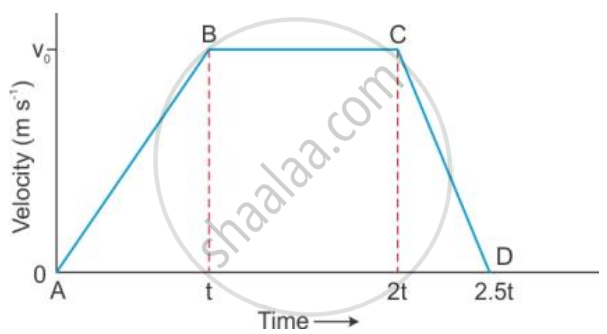
Which part of graph shows motion with uniform
(a) velocity (b) acceleration (c) retardation ?
From the diagram given below, calculate acceleration.
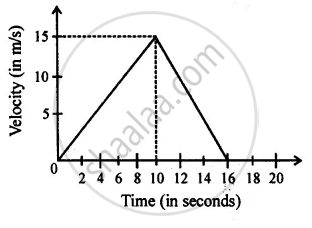
From the diagram given below, calculate deceleration.
Diagram is given below shows velocity – time graph of car P and Q, starting from the same place and in the same direction. Calculate the Acceleration of car Q between 2 s – 5 s.
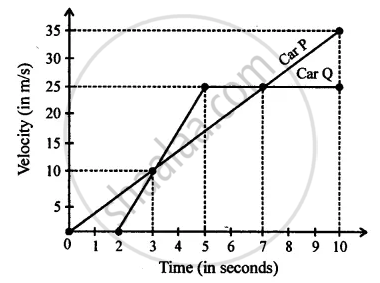
A motorbike, initially at rest, picks up a velocity of 72 kmh−1 over a distance of 40 m. Calculate
- acceleration
- time in which it picks up above velocity.
An aeroplane lands at 216 kmh−1 and stops after covering a runway of 2 m. Calculate the acceleration and the time, in which it comes to rest.
A motor bike running at 5 ms−1, picks up a velocity of 30 ms−1 in 5s. Calculate
- acceleration
- distance covered during acceleration.
A motor bike running at 90 kmh−1 is slowed down to 18 kmh−1 in 2.5 s. Calculate
- acceleration
- distance covered during slow down.
Write the SI unit of acceleration and retardation.
A body has an acceleration of -3.5 ms-2. What is its retardation?
Sketch the shape of the velocity-time graph for a body moving with:
Uniform acceleration.
The graph shows how the velocity of a scooter varies with time in 50 s.
Work out: Acceleration.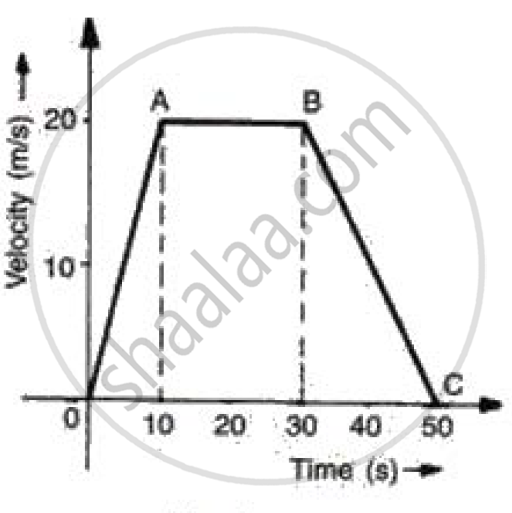
Correct your friend who says that acceleration gives the idea of how fast the position changes.
If the velocity of a body does not change, then its acceleration is ______.
When a body starts from rest, the acceleration of the body after 2 seconds in ______ of its displacement.
When an object undergoes acceleration ______.
A quantity has a value of 16ms-2. It is the ______.
The value of acceleration for a body at rest is ______.
Acceleration is a scalar.
