Advertisements
Advertisements
प्रश्न
Figure represents graphically the velocity of a car moving along a straight road over a period of 100 hours.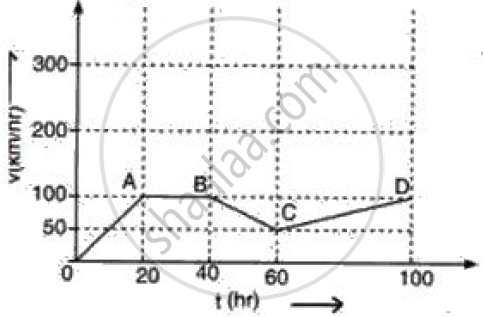
Calculate the acceleration along AB and the retardation along BC.
Advertisements
उत्तर
Acceleration along AB= (100 - 100)/(40 -20) = 0 ms-2
Retardation along CD= (100 - 50)/ (100 - 60) = 50/40 = 1.25 ms-2
APPEARS IN
संबंधित प्रश्न
A car travels with uniform velocity of 25 m s-1 for 5 s. The brakes are then applied and the car is uniformly retarded and comes to rest in further 10 s. Find:
- The distance which the car travels before the brakes are applied,
- Retardation and
- The distance travelled by car after applying the brakes.
The change in velocity of a motorbike is 54 kmh−1 in one minute. Calculate its acceleration in (a) ms−2 (b) kmh−2.
A motorbike, initially at rest, picks up a velocity of 72 kmh−1 over a distance of 40 m. Calculate
- acceleration
- time in which it picks up above velocity.
What does a positive acceleration mean?
A body has an acceleration of -3.5 ms-2. What is its retardation?
A car is moving with a speed of 50 km/h. One second later, its speed is 55 km/h. What is its acceleration?
Correct your friend who says that acceleration gives the idea of how fast the position changes.
Negative acceleration is called ______.
If the velocity of a body does not change, then its acceleration is ______.
An object can be moving with uniform speed but with variable acceleration.
