Advertisements
Advertisements
प्रश्न
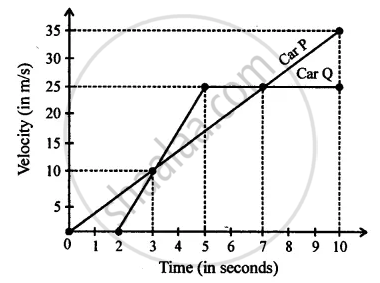
Diagram is given below shows velocity – time graph of car P and Q, starting from the same place and in the same direction. Calculate the Acceleration of car P.
Advertisements
उत्तर

Acceleration of car P = Slope of v.t. graph (OA) for car P.
= `"AB"/"OB"=35/10` = 3.5 ms−2
APPEARS IN
संबंधित प्रश्न
Distinguish between acceleration and retardation.
Define the term acceleration due to gravity. State its average value.
State the type of motion represented by the following sketches in Figures.
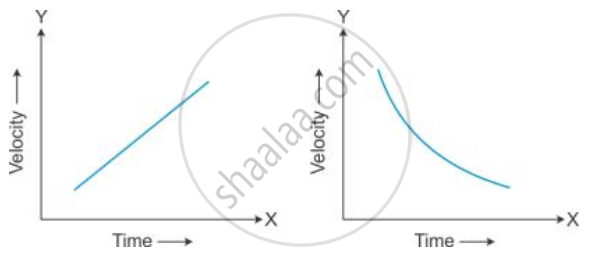
Give an example of each type of motion.
A body falls freely from a certain height. Show graphically the relation between the distance fallen and square of time. How will you determine g from this graph?
Figure given below shows a velocity-time graph for a car starting from rest. The graph has three parts AB, BC and CD.
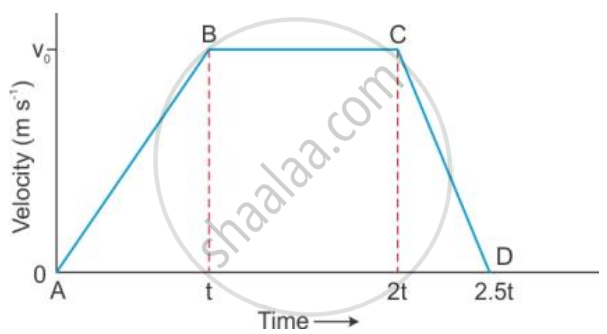
Which part of graph shows motion with uniform
(a) velocity (b) acceleration (c) retardation ?
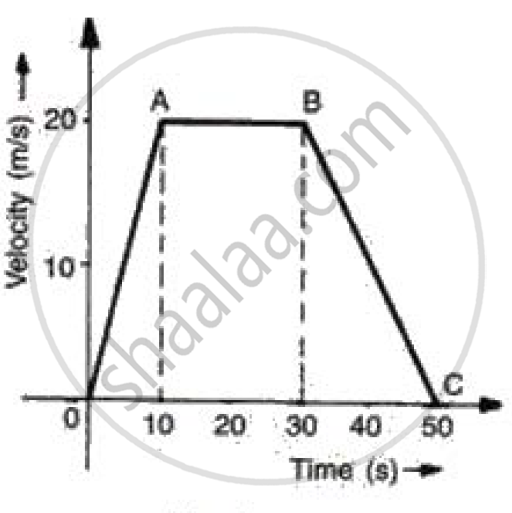
From the diagram given below, calculate deceleration.
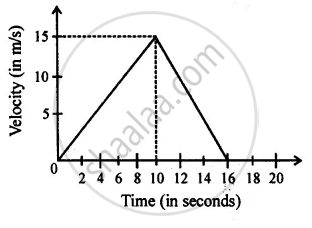
A cyclist driving at 5 ms−1, picks a velocity of 10 ms−1, over a distance of 50 m. Calculate
- acceleration
- time in which the cyclist picks up above velocity.
The acceleration of a moving body is constant in magnitude and direction. Must the path of the body be a straight line?
If not, given an example.
Convert the following acceleration:
1/36 m/s2 into km/h2
The graph shows how the velocity of a scooter varies with time in 50 s.
Work out: Deceleration