Advertisements
Advertisements
प्रश्न
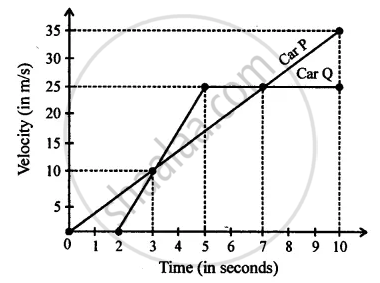
Diagram is given below shows velocity – time graph of car P and Q, starting from the same place and in the same direction. Calculate the Acceleration of car P.
Advertisements
उत्तर

Acceleration of car P = Slope of v.t. graph (OA) for car P.
= `"AB"/"OB"=35/10` = 3.5 ms−2
APPEARS IN
संबंधित प्रश्न
Give a scientific reason.
When an object falls freely to the ground, its acceleration is uniform.
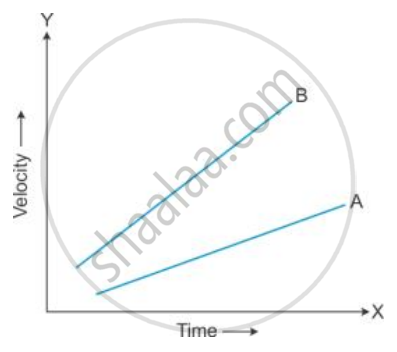
Figure shows the velocity-time graphs for two cars A and B moving in the same direction. Which car has greater acceleration? Give reasons to your answer.
A train starts from rest and accelerates uniformly at a rate of 2 m s−2 for 10 s. It then maintains a constant speed for 200 s. The brakes are then applied and the train is uniformly retarded and comes to rest in 50 s. Find
- The maximum velocity reached,
- The retardation in the last 50 s,
- The total distance travelled,
- The average velocity of the train.
State if the following situation is possible:
A body moving with constant acceleration but with Zero velocity.
A car accelerates uniformly from a velocity of 18 km/h to 36 km/h in 15 min. What is its acceleration?
What do you understand about negative acceleration?
m/s2 is the unit of ______.
Assertion: A positive acceleration of a body can be associated with the slowing down of the body.
Reason: Acceleration is a vector.
Assertion: A negative acceleration of a body can be associated with speeding up of the body.
Reason: Increase in the speed of a moving body is independent of its direction of motion.
Assertion: Position-time graph of a stationary object is a straight line parallel to the time axis.
Reason: For a stationary object, the position does not change with time.
