Advertisements
Advertisements
प्रश्न
A body is moving vertically upwards. Its velocity changes at a constant rate from 50 m s−1 to 20 m s−1 in 3 s. What is its acceleration?
Advertisements
उत्तर
Here, final velocity = 20 m/s
Initial velocity = 50 m/s
Time taken = 3 s
Acceleration = `("Final Velocity" - "Initial Velocity")/"time"`
= `(20 - 50)/3` m/s−2
= −10 m/s−2
The negative sign here indicates that the velocity decreases with time, so retardation is 10 m/s−2.
APPEARS IN
संबंधित प्रश्न
A space craft flying in a straight course with velocity of 75 km s-1 fires its rocket motors for 6.0 s. At the end of this time its speed is 120 km s-1 in the same direction.
Find
(i) The space craft's average acceleration while the motors were firing
(ii) The distance travelled by the space craft in the first 10 s after the rocket motors were started, the motors being in action for only 6 s.
A racing car is moving with a velocity of 50 m/s. On
applying brakes, it is uniformly retarded and comes to rest in 20 seconds. Calculate its acceleration.
A motorbike, initially at rest, picks up a velocity of 72 kmh−1 over a distance of 40 m. Calculate
- acceleration
- time in which it picks up above velocity.
Define acceleration.
The acceleration of a moving body is constant in magnitude and direction. Must the path of the body be a straight line?
If not, given an example.
What does a positive acceleration mean?
A car traveling at 60 km/h, stops on applying brakes in 10 seconds. What is its acceleration?
Distinguish between uniformly and non-uniformly accelerated motions.
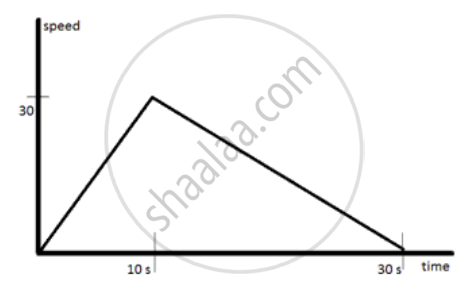
A car accelerates to a velocity of 30 m/s in 10 s and then decelerates for 20 s so that it stops. Draw a velocity-time graph to represent the motion and find:
Distance travelled