Advertisements
Advertisements
प्रश्न
A toy car initially moving with uniform velocity of 18 km h-1 comes to a stop in 2 s. Find the retardation of the car in S.I. units.
Advertisements
उत्तर
initial velocity (u) = 18 km/h-1
final velocity (v) = 0 km/h
time (t) = 2 s
acceleration/retardation (a) = ?
To convert initial velocity u to m s-1
18 km/h-1 = `(18 " km")/(1 " h")`
= `(18 xx 1000 " m")/(60 xx 60 " s")`
⇒ 18 km/h-1 = `(18 xx 10 " m")/(6 xx 6 " s")`
⇒ 18 km/h-1 = 5 m s-1
Acceleration (a) = `("Final Velocity "("v") - "Initial Velocity "("u"))/("time "("t"))`
a = `(0 - 5)/2` m s-2
a = `-(5 "ms"^-1)/"2s"`
a = -2.5 m s-2
Hence, acceleration of the body is -2.5 m s-2. Negative sign shows that the velocity decreases with time, so retardation is 2.5 m s-2.
APPEARS IN
संबंधित प्रश्न
Give an example of an accelerated body, moving with a uniform speed.
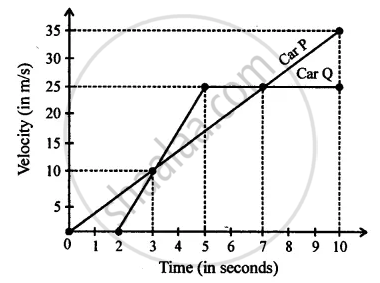
Diagram is given below shows velocity – time graph of car P and Q, starting from the same place and in the same direction. Calculate the Acceleration of car P.
A motor bike running at 5 ms−1, picks up a velocity of 30 ms−1 in 5s. Calculate
- acceleration
- distance covered during acceleration.
The speed of a car increases from 10 km/h to 64 km/h in 10 seconds. What will be its acceleration?
State if the following situation is possible:
A body moving with a constant velocity in an accelerated motion.
Sketch the shape of the velocity-time graph for a body moving with:
Uniform acceleration.
The graph shows how the velocity of a scooter varies with time in 50 s.
Work out: Deceleration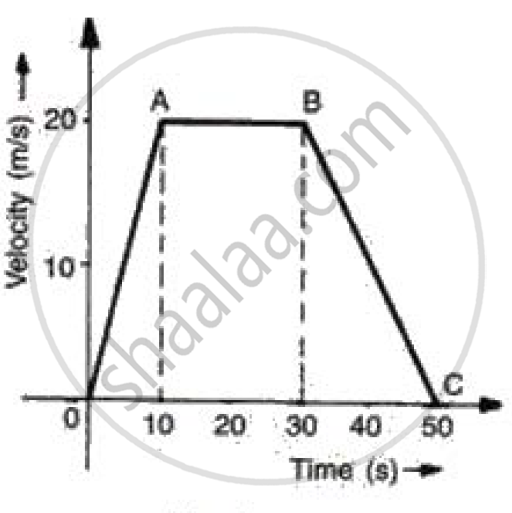
The rate of change of velocity is ______.
What do you mean by constant acceleration?
Assertion: When a body is subjected to a uniform acceleration, it is always moving in a straight line.
Reason: Motion may be straight-line motion or circular motion.
