Advertisements
Advertisements
प्रश्न
The speed of a car increases from 10 km/h to 64 km/h in 10 seconds. What will be its acceleration?
Advertisements
उत्तर
Initial velocity u = 10 km/hr. = (10 X 1000)/3600 = 8.33 ms-1.
Final velocity = 64 km/hr = (64 X 1000)/3600 = 17.77 ms-1.
Time = 10 s.
Acceleration = (v-u)/t = (17.77- 8.33)/10 = 9.44/10 = 0.94 ms-2.
APPEARS IN
संबंधित प्रश्न
A body is moving vertically upwards. Its velocity changes at a constant rate from 50 m s−1 to 20 m s−1 in 3 s. What is its acceleration?
A space craft flying in a straight course with velocity of 75 km s-1 fires its rocket motors for 6.0 s. At the end of this time its speed is 120 km s-1 in the same direction.
Find
(i) The space craft's average acceleration while the motors were firing
(ii) The distance travelled by the space craft in the first 10 s after the rocket motors were started, the motors being in action for only 6 s.
Explain the following concept in your own words with everyday examples:
Acceleration
From the diagram given below, calculate acceleration.
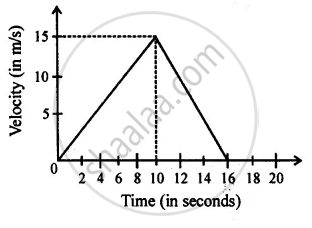
A truck running at 90 kmh−1, is brought to rest over a distance of 25 m. Calculate the retardation and time for which brakes are applied.
A racing car, initially at rest, picks up a velocity of 180 kmh−1 in 4.5 s. Calculate
- acceleration
- distance covered by the car.
The distance covered by a body is directly proportional to the square of the time elapsed. What can you say about its acceleration?
A body has an acceleration of -3.5 ms-2. What is its retardation?
Assertion: A positive acceleration of a body can be associated with the slowing down of the body.
Reason: Acceleration is a vector.
Assertion: A negative acceleration of a body can be associated with speeding up of the body.
Reason: Increase in the speed of a moving body is independent of its direction of motion.
