हिंदी

A car accelerates to a velocity of 30 m/s in 10 s and then decelerates for 20 s so that it stops. Draw a velocity-time graph to represent the motion and find:The Deceleration.

Advertisements
Advertisements

प्रश्न

A car accelerates to a velocity of 30 m/s in 10 s and then decelerates for 20 s so that it stops. Draw a velocity-time graph to represent the motion and find:
The Deceleration.
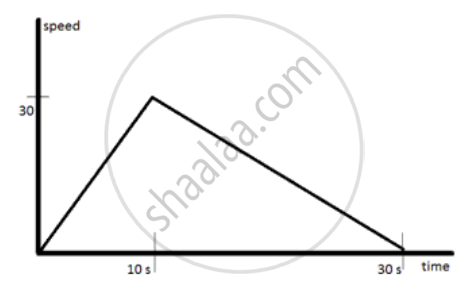
आकृति
टिप्पणी लिखिए
Advertisements

उत्तर

Deceleration a = ( v - u )/t = ( o - 30 )/ 20 = -1.5 ms-2

shaalaa.com
  क्या इस प्रश्न या उत्तर में कोई त्रुटि है?
अध्याय 2: Motion in One Dimension - Exercise 3 [पृष्ठ ८६]

APPEARS IN

फ्रैंक Physics Part 1 [English] Class 9 ICSE
अध्याय 2 Motion in One Dimension
Exercise 3 | Q 53.2 | पृष्ठ ८६

संबंधित प्रश्न

An object of mass 16 kg is moving with an acceleration of 3 m/s2. Calculate the applied force. If the same force is applied to an object of mass 24 kg, how much will be the acceleration?


Draw velocity – time graph for the following situation:

When a body is moving with variable velocity, but uniform retardation.


A cyclist driving at 36 kmh−1 stops his motion in 2 s, by the application of brakes. Calculate

  1. retardation
  2. distance covered during the application of brakes.

Out of energy and acceleration, which one is a vector?


A car accelerates to a velocity of 30 m/s in 10 s and then decelerates for 20 s so that it stops. Draw a velocity-time graph to represent the motion and find:
The acceleration.


A car accelerates to a velocity of 30 m/s in 10 s and then decelerates for 20 s so that it stops. Draw a velocity-time graph to represent the motion and find:
Distance travelled


A bus can accelerate with an acceleration of 1 m/s2 . Find the minimum time for the bus to attain the speed of 100 km/s from 50 km /s.


Assertion: The accelerated motion of an object may be due to change in magnitude of velocity or direction or both of them.

Reason: Acceleration can be produced only by change in magnitude of the velocity. It does not depend the direction.


Assertion: When a body is subjected to a uniform acceleration, it is always moving in a straight line.
Reason: Motion may be straight-line motion or circular motion.


When a body is said to be in

  1. uniform acceleration
  2. non–uniform acceleration?

Share
Notifications

Englishहिंदीमराठी


      Forgot password?
Use app×