Advertisements
Advertisements
प्रश्न
A car accelerates to a velocity of 30 m/s in 10 s and then decelerates for 20 s so that it stops. Draw a velocity-time graph to represent the motion and find:
The Deceleration.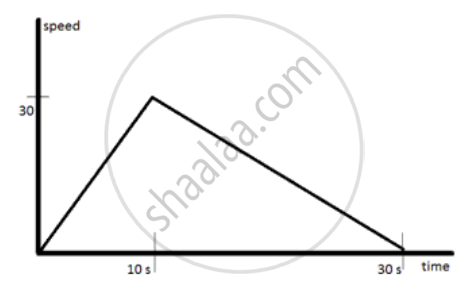
Advertisements
उत्तर

Deceleration a = ( v - u )/t = ( o - 30 )/ 20 = -1.5 ms-2
APPEARS IN
संबंधित प्रश्न
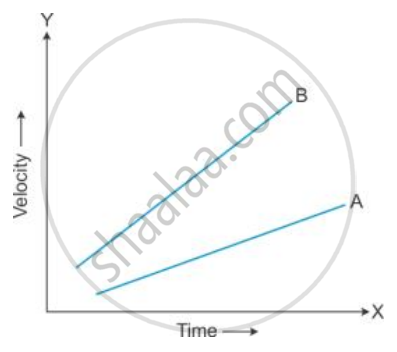
Figure shows the velocity-time graphs for two cars A and B moving in the same direction. Which car has greater acceleration? Give reasons to your answer.
Draw velocity – time graph for the following situation:
When a body is moving with variable velocity and variable acceleration.
An aeroplane lands at 216 kmh−1 and stops after covering a runway of 2 m. Calculate the acceleration and the time, in which it comes to rest.
What is the SI unit of acceleration?
The distance covered by a body is directly proportional to the square of the time elapsed. What can you say about its acceleration?
What happens to the stepwise increasing speed-time graph when the size of each step is made very small?
A car accelerates to a velocity of 30 m/s in 10 s and then decelerates for 20 s so that it stops. Draw a velocity-time graph to represent the motion and find:
Distance travelled
m/s2 is the unit of ______.
A car is being driven at a speed of 20ms-1 when brakes are applied to bring it to rest in 5 s. The deceleration produced in this case will be ______.
What is the difference between uniform acceleration and non–uniform acceleration?
