Advertisements
Advertisements
प्रश्न
A car accelerates uniformly from a velocity of 18 km/h to 36 km/h in 15 min. What is its acceleration?
Advertisements
उत्तर
Initial velocity of car u = 18 km/hr.
Final velocity of car v= 36 km/hr.
Time taken by body = 15 min. = 1/4 hr
Acceleration of car a = ( v- u )/t = (36 - 18 ) X 4 = 72 kmh-2.
APPEARS IN
संबंधित प्रश्न
Give a scientific reason.
When an object falls freely to the ground, its acceleration is uniform.
A body is moving vertically upwards. Its velocity changes at a constant rate from 50 m s−1 to 20 m s−1 in 3 s. What is its acceleration?
A toy car initially moving with uniform velocity of 18 km h-1 comes to a stop in 2 s. Find the retardation of the car in S.I. units.
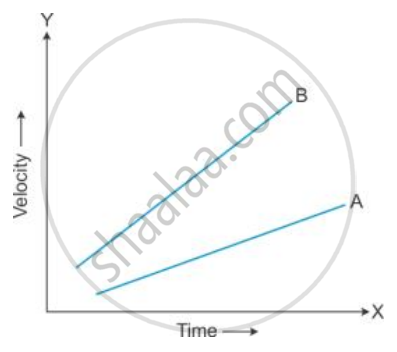
Figure shows the velocity-time graphs for two cars A and B moving in the same direction. Which car has greater acceleration? Give reasons to your answer.
Draw a graph for acceleration against time for a uniformly accelerated motion. How can it be used to find the change in speed in a certain interval of time?
If a body is moving with a constant velocity its acceleration is ______.
Draw velocity – time graph for the following situation:
When a body is moving with variable velocity and variable acceleration.
The acceleration of a body is 8.5 ms-2. What does this statement mean?
The initial velocity of a car is 10 ms-1. It moves with an acceleration of 2 ms-2. What will be its speed after 10 seconds?
Assertion: When a body is subjected to a uniform acceleration, it is always moving in a straight line.
Reason: Motion may be straight-line motion or circular motion.
