Advertisements
Advertisements
प्रश्न
A vehicle is accelerating on a straight road. Its velocity at any instant is 30 km/h. After 2 s, it is 33.6 km/h, and after further 2 s, it is 37.2 km/h. Find the acceleration of the vehicle in m s-2. Is the acceleration uniform?
Advertisements
उत्तर
Acceleration = Change in velocity/time taken
In the first two seconds,
Acceleration = [(33.6 - 30)/2] km/s2
= 1.8 km/s2
= 0.5 m/s2 …(i)
In the next two seconds,
Acceleration = [(37.2 - 33.6)/2] km/s2
= 1.8 km/s2
= 0.5 m/s-2…(ii)
From (i) and (ii), we can say that the acceleration is uniform.
APPEARS IN
संबंधित प्रश्न
A toy car initially moving with uniform velocity of 18 km h-1 comes to a stop in 2 s. Find the retardation of the car in S.I. units.
A ball is rolling from A to D on a flat and smooth surface. Its speed is 2 cm/s. On reaching B, it was pushed continuously up to C. On reaching D from C, its speed had become 4 cm/s. It took 2 seconds for it to go from B to C. What is the acceleration of the ball as it goes from B to C?

A truck running at 90 kmh−1, is brought to rest over a distance of 25 m. Calculate the retardation and time for which brakes are applied.
Write the SI unit of acceleration and retardation.
The speed of a car increases from 10 km/h to 64 km/h in 10 seconds. What will be its acceleration?
Is it possible for an accelerating body to have constant speed?
Interpret the following graph: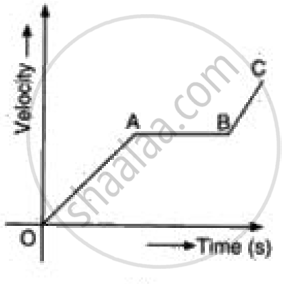
When a body starts from rest, the acceleration of the body after 2 seconds in ______ of its displacement.
Acceleration is a scalar.
Assertion: Position-time graph of a stationary object is a straight line parallel to the time axis.
Reason: For a stationary object, the position does not change with time.
