Advertisements
Advertisements
प्रश्न
The velocity-time graph for a uniformly retarded body is a straight line inclined to the time axis with an obtuse angle. How is retardation calculated from the velocity-time graph?
Advertisements
उत्तर
retardation is calculated by finding the negative slope.
APPEARS IN
संबंधित प्रश्न
Give a scientific reason.
When an object falls freely to the ground, its acceleration is uniform.
What is meant by the term retardation? Name its S.I. unit.
A body is moving vertically upwards. Its velocity changes at a constant rate from 50 m s−1 to 20 m s−1 in 3 s. What is its acceleration?
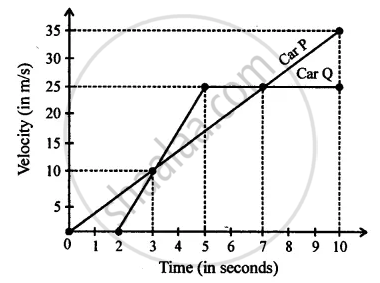
Diagram is given below shows velocity – time graph of car P and Q, starting from the same place and in the same direction. Calculate the Acceleration of car P.
A truck running at 90 kmh−1, is brought to rest over a distance of 25 m. Calculate the retardation and time for which brakes are applied.
The Unit of acceleration is ______.
m/s2 is the unit of ______.
When an object undergoes acceleration ______.
A car is being driven at a speed of 20ms-1 when brakes are applied to bring it to rest in 5 s. The deceleration produced in this case will be ______.
An object can be moving with uniform speed but with variable acceleration.
