Advertisements
Advertisements
प्रश्न
A body is moving vertically upwards. Its velocity changes at a constant rate from 50 m s−1 to 20 m s−1 in 3 s. What is its acceleration?
Advertisements
उत्तर
Here, final velocity = 20 m/s
Initial velocity = 50 m/s
Time taken = 3 s
Acceleration = `("Final Velocity" - "Initial Velocity")/"time"`
= `(20 - 50)/3` m/s−2
= −10 m/s−2
The negative sign here indicates that the velocity decreases with time, so retardation is 10 m/s−2.
APPEARS IN
संबंधित प्रश्न
Figure given below shows a velocity-time graph for a car starting from rest. The graph has three parts AB, BC and CD.
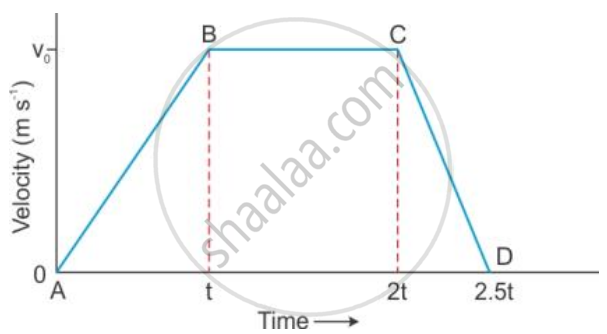
(a) Is the magnitude of acceleration higher or lower than that of retardation ? Give a reason .
(b) Compare the magnitude of acceleration and retardation .
A ball is rolling from A to D on a flat and smooth surface. Its speed is 2 cm/s. On reaching B, it was pushed continuously up to C. On reaching D from C, its speed had become 4 cm/s. It took 2 seconds for it to go from B to C. What is the acceleration of the ball as it goes from B to C?

State its value in C.G.S. as well as in S.I. system.
A racing car, initially at rest, picks up a velocity of 180 kmh−1 in 4.5 s. Calculate
- acceleration
- distance covered by the car.
Define acceleration.
A car traveling at 60 km/h, stops on applying brakes in 10 seconds. What is its acceleration?
From the given v-t graph it can be inferred that an object is

A bus can accelerate with an acceleration of 1 m/s2 . Find the minimum time for the bus to attain the speed of 100 km/s from 50 km /s.
Acceleration is defined as the rate of change of ______.
Acceleration is a scalar.
