Advertisements
Advertisements
प्रश्न
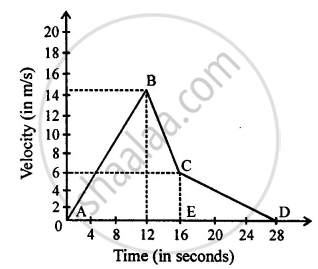
From the velocity – time graph given below, calculate deceleration in region BC.
Advertisements
उत्तर
Deceleration in the region B = +Slope of v.t. graph from B to C
= `"BG"/"GC"=(14-6)/(16-12)=8/4` = 2 ms−2
APPEARS IN
संबंधित प्रश्न
An object of mass 16 kg is moving with an acceleration of 3 m/s2. Calculate the applied force. If the same force is applied to an object of mass 24 kg, how much will be the acceleration?
When is the acceleration due to gravity negative?
A racing car is moving with a velocity of 50 m/s. On
applying brakes, it is uniformly retarded and comes to rest in 20 seconds. Calculate its acceleration.
A body falls towards the earth. Does it have positive or negative acceleration?
Distinguish between uniformly and non-uniformly accelerated motions.
Can you use the relation [B1]?
Convert the following acceleration:
7200 km/h2 into m/s2
Exercise Problem.
A racing car has a uniform acceleration of 4 ms–2. What distance it covers in 10 s after the start?
If a moving body comes to rest, then its acceleration is ______.
Acceleration is a scalar.
