Advertisements
Advertisements
प्रश्न
A body falls freely from a certain height. Show graphically the relation between the distance fallen and square of time. How will you determine g from this graph?
Advertisements
उत्तर

The value of acceleration due to gravity (g) can be obtained by doubling the slope of the S - t2 graph for a freely falling body.
संबंधित प्रश्न
A space craft flying in a straight course with velocity of 75 km s-1 fires its rocket motors for 6.0 s. At the end of this time its speed is 120 km s-1 in the same direction.
Find
(i) The space craft's average acceleration while the motors were firing
(ii) The distance travelled by the space craft in the first 10 s after the rocket motors were started, the motors being in action for only 6 s.
Draw velocity – time graph for the following situation:
When a body is moving with variable velocity, but uniform retardation.
From the diagram given below, calculate acceleration.
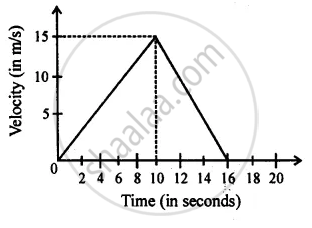
An aeroplane lands at 216 kmh−1 and stops after covering a runway of 2 m. Calculate the acceleration and the time, in which it comes to rest.
A truck running at 90 kmh−1, is brought to rest over a distance of 25 m. Calculate the retardation and time for which brakes are applied.
A body falls towards the earth. Does it have positive or negative acceleration?
State if the following situation is possible:
A body moving with constant acceleration but with Zero velocity.
What is meant by negative acceleration?
A boy throws a ball up and catches it when the ball falls back. In which part of the motion the ball is accelerating?
An object can be moving with uniform speed but with variable acceleration.
