Advertisements
Advertisements
प्रश्न
An aeroplane lands at 216 kmh−1 and stops after covering a runway of 2 m. Calculate the acceleration and the time, in which it comes to rest.
Advertisements
उत्तर
Initial velocity = u = 216 kmh−1
u = `216xx5/18` = 60 ms−1
Final velocity = v = 0
Distance = S = 2 km = 2000 m
v2 − u2 = 2aS
(0)2 − (60)2 = 2a (2000)
4000 a = −3600
(Acceleration) a = `(-3600)/4000`
= −0.9 ms−2
Now, v = u + at
0 = 60 + (−0.9)t
0.9t = 60
(Time) t = `60/0.9=600/9` = 66.67 S
APPEARS IN
संबंधित प्रश्न
Distinguish between acceleration and retardation.
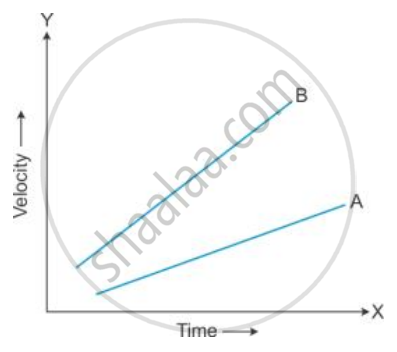
Figure shows the velocity-time graphs for two cars A and B moving in the same direction. Which car has greater acceleration? Give reasons to your answer.
If a body is moving with a constant velocity its acceleration is ______.
A body falls towards the earth. Does it have positive or negative acceleration?
State if the following situation is possible:
A body moving with a constant velocity in an accelerated motion.
Sketch the shape of the velocity-time graph for a body moving with:
Uniform acceleration.
A car accelerates uniformly from a velocity of 18 km/h to 36 km/h in 15 min. What is its acceleration?
A car starts from rest and it is travelling with a velocity of 20 m/s in 10 s. What is its acceleration?
State whether true or false. If false, correct the statement.
Acceleration can get negative value also.
What do you understand about negative acceleration?
