Advertisements
Advertisements
प्रश्न
The distance covered by a body is directly proportional to the square of the time elapsed. What can you say about its acceleration?
Advertisements
उत्तर
This means the body has a positive acceleration.
APPEARS IN
संबंधित प्रश्न
An object of mass 16 kg is moving with an acceleration of 3 m/s2. Calculate the applied force. If the same force is applied to an object of mass 24 kg, how much will be the acceleration?
From the diagram given below, calculate acceleration.
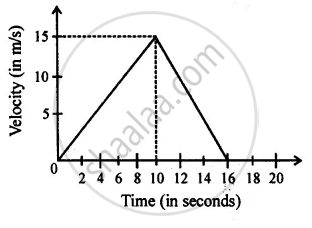
From the diagram given below, calculate deceleration.
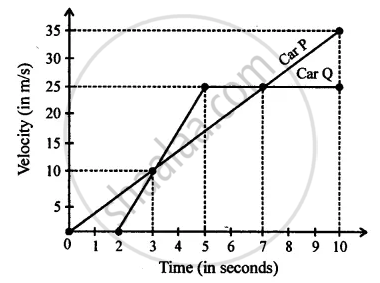
Diagram is given below shows velocity – time graph of car P and Q, starting from the same place and in the same direction. Calculate the Acceleration of car Q between 2 s – 5 s.
A motor bike running at 5 ms−1, picks up a velocity of 30 ms−1 in 5s. Calculate
- acceleration
- distance covered during acceleration.
Can you use the relation [B1]?
The speed of a car increases from 10 km/h to 64 km/h in 10 seconds. What will be its acceleration?
Is it possible for an accelerating body to have constant speed?
When a body starts from rest, the acceleration of the body after 2 seconds in ______ of its displacement.
If a moving body comes to rest, then its acceleration is ______.
