Advertisements
Advertisements
प्रश्न
A motor bike running at 5 ms−1, picks up a velocity of 30 ms−1 in 5s. Calculate
- acceleration
- distance covered during acceleration.
Advertisements
उत्तर
Initial velocity of motor bike = u = 5 ms−1
Final velocity of motor bike = v = 30 ms−1
Time = t = 5 s
(i) Acceleration = a = ?
v = u + at
30 = 5 + a (5)
5a = 30 − 5 = 25
a = `25/5` = 5 ms−2
(ii) Distance covered S =?
S = ut + `1/2` at2
S = `5(5)+1/2(5)(5)^2`
S = `25+125/2` = 25 + 62.5
S = 87.5 m
APPEARS IN
संबंधित प्रश्न
The velocity-time graph for a uniformly retarded body is a straight line inclined to the time axis with an obtuse angle. How is retardation calculated from the velocity-time graph?
Figure given below shows a velocity-time graph for a car starting from rest. The graph has three parts AB, BC and CD.
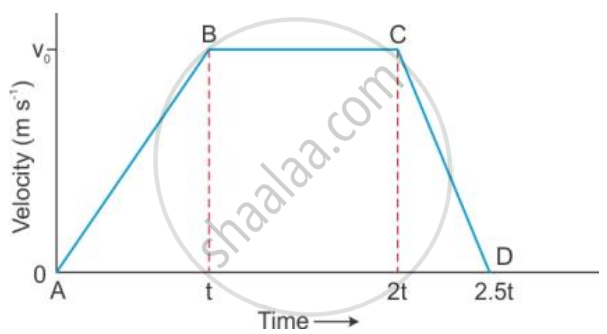
Which part of graph shows motion with uniform
(a) velocity (b) acceleration (c) retardation ?
When is the acceleration due to gravity positive?
The acceleration of a moving body is constant in magnitude and direction. Must the path of the body be a straight line?
If not, given an example.
The acceleration of a body is 8.5 ms-2. What does this statement mean?
Write the SI unit of retardation.
A body has an acceleration of -3.5 ms-2. What is its retardation?
A car accelerates uniformly from a velocity of 18 km/h to 36 km/h in 15 min. What is its acceleration?
The rate of change of velocity is ______.
Assertion: A negative acceleration of a body can be associated with speeding up of the body.
Reason: Increase in the speed of a moving body is independent of its direction of motion.
