Advertisements
Advertisements
प्रश्न
A motorbike, initially at rest, picks up a velocity of 72 kmh−1 over a distance of 40 m. Calculate
- acceleration
- time in which it picks up above velocity.
Advertisements
उत्तर
Initial velocity = u = 0
Final velocity = v = 72 km/h = `72xx5/18` m/s
v = 20 m/s
Distance = S = 40 m
(i) v2 − u2 = 2aS
(20)2 − (0)2 = 2a (40)
80a = 400
a = `400/80`
a = 5 ms−2
(ii) v = u + at
20 = 0 + 5t
5t = 20
t = `20/5`
t = 4 s
APPEARS IN
संबंधित प्रश्न
Define acceleration. State its unit.
A toy car initially moving with uniform velocity of 18 km h-1 comes to a stop in 2 s. Find the retardation of the car in S.I. units.
A bullet initially moving with a velocity 20 m/s strikes a target and comes to rest after penetrating a distance 10 cm into the target. Calculate the retardation caused by the target.
A ball is rolling from A to D on a flat and smooth surface. Its speed is 2 cm/s. On reaching B, it was pushed continuously up to C. On reaching D from C, its speed had become 4 cm/s. It took 2 seconds for it to go from B to C. What is the acceleration of the ball as it goes from B to C?

When is the acceleration due to gravity negative?
An aeroplane lands at 216 kmh−1 and stops after covering a runway of 2 m. Calculate the acceleration and the time, in which it comes to rest.
Convert the following acceleration:
7200 km/h2 into m/s2
The graph shows how the velocity of a scooter varies with time in 50 s.
Work out: Acceleration.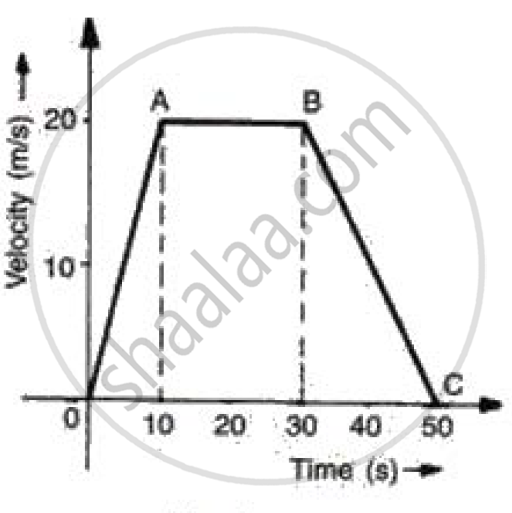
The acceleration of the body that moves with a uniform velocity will be ______.
A bus accelerating with 4ms-2 changes its speed from 60ms_1 to a certain value in 5s. The final speed is ______.
