Advertisements
Advertisements
प्रश्न
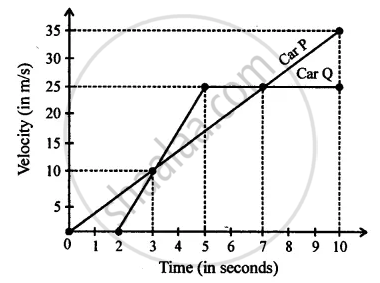
Diagram is given below shows velocity – time graph of car P and Q, starting from the same place and in the same direction. Calculate which car is ahead after 10 s and by how much?
Advertisements
उत्तर

Distance covered by car P = area of ΔOAB
= `1/2xx"OB"xx"AB"`
= `1/2xx10xx35`
= 175 m
Distance covered by car Q = area of ΔCDE + area of rectangle DFBE
= `1/2xx"CE"xx"DE"+"EB"xx"BF"`
= `1/2xx(5-2)xx25+(10-5)xx25`
= `75/2+125`
= 37.5 + 125
= 162.5 m
So, car P is a head of car Q by (175 − 162.5) m
i.e. by 12.5 m
APPEARS IN
संबंधित प्रश्न
What does the slope of a speed-time graph indicate ?
The speed-time graph of an ascending passenger lift is given alongside. What is the acceleration of the lift:
(1) during the first two seconds ?
(2) between second and tenth second ?
(3) during the last two seconds ?
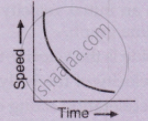
What type of motion is represented by the following graph ?
Draw a velocity-time graph for the free fall of a body under gravity starting from rest. Take g = 10m s-2
Multiple choice Question. Select the correct option.
A graph is a straight line parallel to the time axis in a distance-time graph. From the graph, it implies:
Represent the position of a body described as at 15 m, 30o north of west, on a graph paper.
Sketch the shape of the velocity-time graph for a body moving with:
Uniformly velocity
Figure shows the distance-time graph of three students A, B and C. On the basis of the graph, answer the following :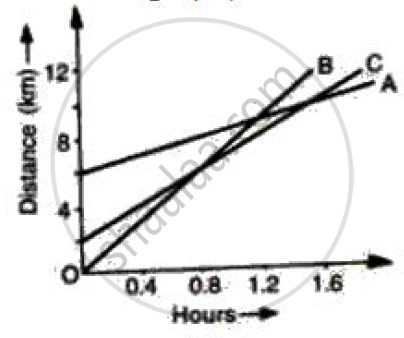
Which of the three is traveling the fastest?
State whether true or false. If false, correct the statement.
The velocity – time graph of a particle falling freely under gravity would be a straight line parallel to the x axis.
If the velocity-time graph has the shape AMB, what would be the shape of the corresponding acceleration-time graph?

