Advertisements
Advertisements
प्रश्न
Draw the speed-time graph of a body when its initial speed is not zero and the speed increases uniformly with time.
Advertisements
उत्तर

Speed time graph of a body when itS Initial speed is not ze ro and and speed increase uniformly with time.
APPEARS IN
संबंधित प्रश्न
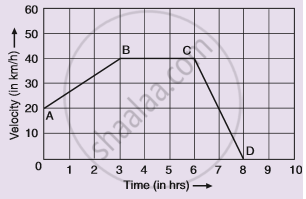
Given alongside is the velocity-time graph for a moving body :
Find :
(i) Velocity of the body at point C.
(ii) Acceleration acting on the body between A and B.
(iii) Acceleration acting on the body between B and C.
Multiple choice Question. Select the correct option.
The slope of displacement – time graph represents.
Diagram shows a velocity – time graph for a car starting from rest. The graph has three sections AB, BC and CD.
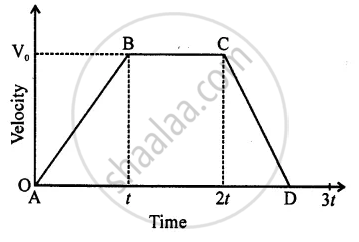
From a study of this graph, state how the distance travelled in any section is determined.
Represent the location of an object described as at 15 m, 45o west of north, on a graph paper.
What can you conclude if the speed-time graph of a body is a curve moving upwards starting from the origin?
Its time-displacement graph is a straight line.
Figure shows the distance-time graph of three students A, B and C. On the basis of the graph, answer the following :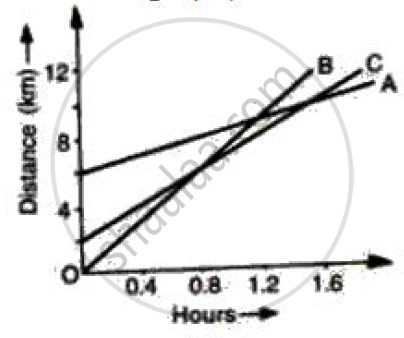
When B meets A, where is C?
The slope of the speed–time graph gives ______.
The area under the v-t graph represents a physical quantity that has the unit.
Slope of the velocity-time graph gives ______.
