Advertisements
Advertisements
प्रश्न
Multiple choice Question. Select the correct option.
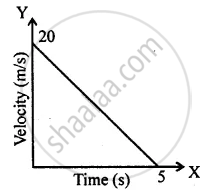
The distance covered in the adjoining velocity-time graph is :
पर्याय
25 m
40 m
50 m
45 m
Advertisements
उत्तर
50 m
Explanation:
Distance covered = Area under velocity – time graph
=1/2 × base × height
a = 1/2 × 5 × 20 = 50 m
APPEARS IN
संबंधित प्रश्न
What does the slope of velocity-time graph represent?
From the displacement-time graph of a cyclist given below in the Figure, find The time after which he reaches the starting point .
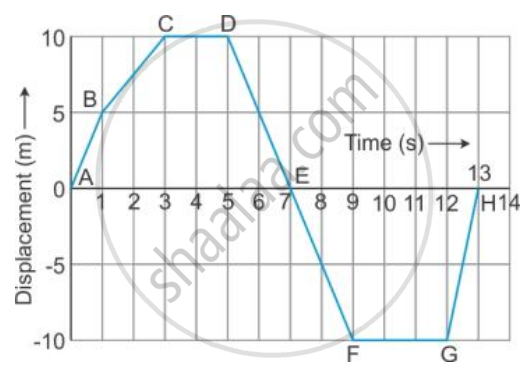
Diagram shows a velocity – time graph for a car starting from rest. The graph has three sections AB, BC and CD.
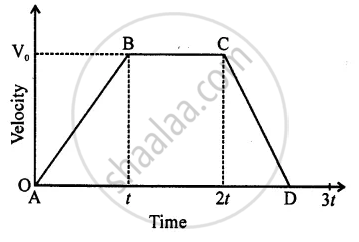
From a study of this graph, state how the distance travelled in any section is determined.
The area of the right triangle under a speed-time graph is 500 m, in a time interval of 20 s. What is the speed of the body? Is the motion uniform or non-uniform?
Interpret the following graph: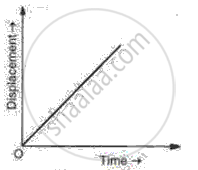
Given below are the speed -time graphs. Match them with their corresponding motions :
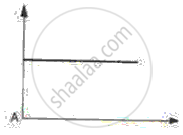 |
(a) Uniformity retared motion |
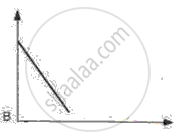 |
(b) Non-uniformity acceleration |
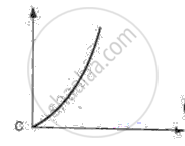 |
(c) Non-uniform motion |
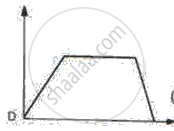 |
(d) uniform motion |
Figure shows displacement- time graph of two objects A and B moving in a stra ight line. Which object is moving fa ster?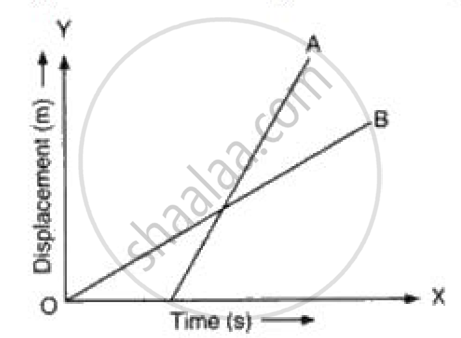
State whether true or false. If false, correct the statement.
The velocity – time graph of a particle falling freely under gravity would be a straight line parallel to the x axis.
State whether true or false. If false, correct the statement.
If the velocity – time graph of a particle is a straight line inclined to X-axis then its displacement – time graph will be a straight line.
A straight line parallel to the x-axis in the velocity-time graph represents the object moving in ______.
