Advertisements
Advertisements
Question
Multiple choice Question. Select the correct option.
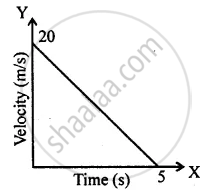
The distance covered in the adjoining velocity-time graph is :
Options
25 m
40 m
50 m
45 m
Advertisements
Solution
50 m
Explanation:
Distance covered = Area under velocity – time graph
=1/2 × base × height
a = 1/2 × 5 × 20 = 50 m
APPEARS IN
RELATED QUESTIONS
The velocity-time graph for part of a train journey is a horizontal straight line. What does this tell you about its acceleration ?
What type of motion is represented by the following graph ?
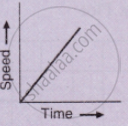
For uniform motion _________
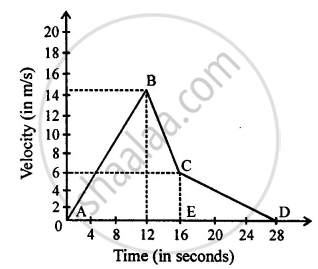
From the velocity – time graph given below, calculate Distance covered in the region ABCE.
Draw the following graph:
Distance versus time for a body at rest.
Draw distance-time graph to show:
Decreasing velocity
Figure shows the velocity-time graphs for two objects A and B moving in same direction . Which object has the greater a cceleration?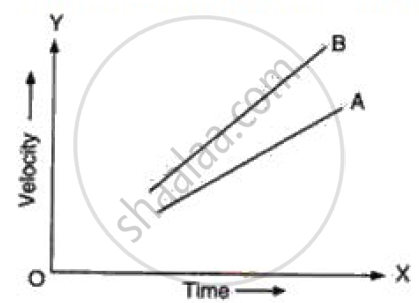
Draw the distance-time graphs of the bodies P and Q starting from rest, moving with uniform speeds with P moving faster than Q.
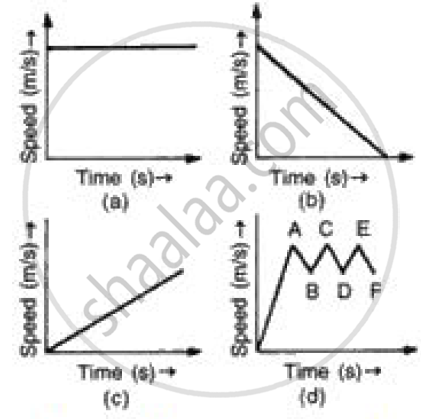
(i) In speed time graph uniform motion is given by a straight line parallel to x axis so figure (a) denotes the uniform motion.
(ii) In speed time graph motion with increasing speed is shown by straight line with positive slope so figure (c) denotes the motion with speed increasing.
(iii) In speed time graph motion with decreasing speed is shown by straight line with negative slope so figure (b) denotes the motion with speed decreasing.
(iv) In speed time graph motion with oscillating speed is shown by zigzag line so figure {d) denotes the motion with speed oscillating.
The area of the velocity-time graph gives the displacement of the body.
