Advertisements
Advertisements
Question
What can you conclude if the speed-time graph of a body is a straight line sloping upwards and not passing through the origin?
Advertisements
Solution
Speed time graph is moving upward then the body is accelerating and if it is not starting from origin then it means the body has some initial velocity.
APPEARS IN
RELATED QUESTIONS
The velocity-time graph for part of a train journey is a horizontal straight line. What does this tell you about its acceleration ?
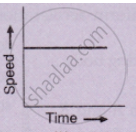
What type of motion is represented by the following graph ?
What does the slope of velocity-time graph represent?
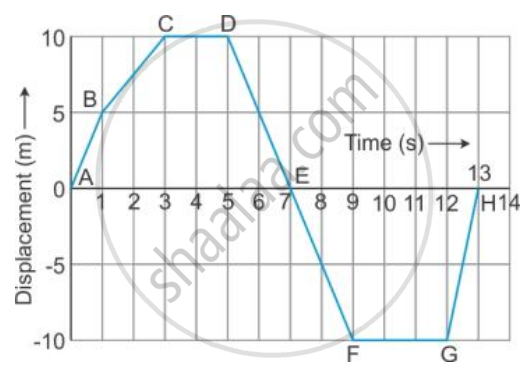
From the displacement-time graph of a cyclist given below in the Figure, find The time after which he reaches the starting point .
A ball is thrown up vertically and returns back to thrower in 6 s. Assuming there is no air friction, plot a graph between velocity and time. From the graph calculate
- deceleration
- acceleration
- total distance covered by ball
- average velocity.
How will you use a speed-time graph to find whether the acceleration of the body is uniform or not?
Draw the speed-time graph of a body starting from some point P, gradually picking up speed, then running at a uniform speed and finally slowing down to stop at some point Q.
Its time-displacement graph is a straight line.
Draw the distance-time graphs of the bodies P and Q starting from rest, moving with uniform speeds with P moving faster than Q.
The slope of the speed–time graph gives ______.
