Advertisements
Advertisements
Question
The speed-time graph of an ascending passenger lift is given alongside. What is the acceleration of the lift:
(1) during the first two seconds ?
(2) between second and tenth second ?
(3) during the last two seconds ?
Advertisements
Solution
(i) We have to find the acceleration from the given graph.
Acceleration = slope of line AB
= `((4.6-0))/((2-0)) "m/s"^2`
= 2.3 `"m/s"^2`
(ii) Between second and tenth second, it represents uniform speed, so, acceleration acting on the lift is zero.
(iii) During the last two seconds, it represents retardation of the lift, so its acceleration is (–2.3 m/s2).
APPEARS IN
RELATED QUESTIONS
The velocity-time graph for part of a train journey is a horizontal straight line. What does this tell you about the trains velocity.
A body is moving uniformly in a straight line with a velocity of 5 m/s. Find graphically the distance covered by it in 5 seconds.
Define speed. What is its S.I. unit?
What does the area of an acceleration – time graph represent?
Multiple choice Question. Select the correct option.
In the velocity-time graph, the acceleration is
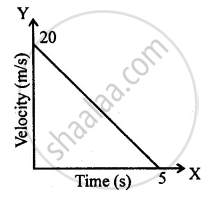
Draw velocity – time graph for the following situation:
When a body is moving with variable velocity, but uniform acceleration.
Interpret the following graph: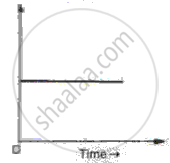
Figure shows displacement- time graph of two objects A and B moving in a stra ight line. Which object is moving fa ster?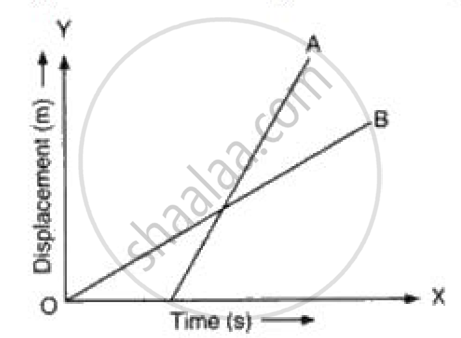
The area under velocity – time graph represents the ______
State whether true or false. If false, correct the statement.
If the velocity – time graph of a particle is a straight line inclined to X-axis then its displacement – time graph will be a straight line.
