Advertisements
Advertisements
Question
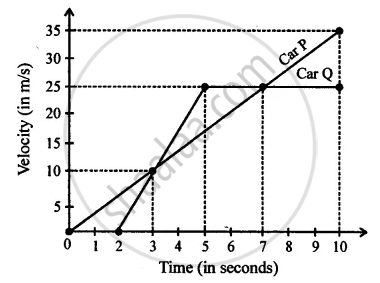
Diagram is given below shows velocity – time graph of car P and Q, starting from the same place and in the same direction. Calculate at what time intervals both cars have the same velocity?
Advertisements
Solution

Both cars have the same velocity at t = 3 s and at t = 7 s.
APPEARS IN
RELATED QUESTIONS
Name the two quantities, the slope of whose graph give acceleration.
Diagram shows a velocity – time graph for a car starting from rest. The graph has three sections AB, BC, and CD.
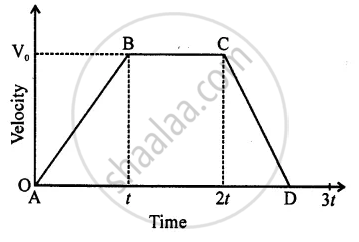
In which section, car has a zero acceleration?
A train starting from rest picks up a speed of 20 ms−1 in 200 s. It continues to move at the same rate for the next 500 s and is then brought to rest in another 100 s.
- Plot a speed-time graph.
- From graph calculate
(a) uniform rate of acceleration
(b) uniform rate of retardation
(c) total distance covered before stopping
(d) average speed.
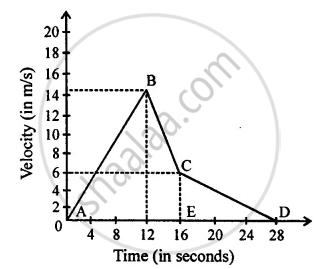
From the velocity – time graph given below, calculate acceleration in the region AB.
How does the slope of a speed-time graph give the acceleration of a body moving along a straight line?
Draw the speed-time graph of a body starting from some point P, gradually picking up speed, then running at a uniform speed and finally slowing down to stop at some point Q.
Draw the following graph:
Speed versus time for a non-uniform acceleration.
Draw velocity-time graph to show:
Zero acceleration
Write a sentence to explain the shape of graph.
Mention the uses of the velocity-time graph.
The given graph shows the variation of velocity (v) with position (x) for a particle moving along a straight line
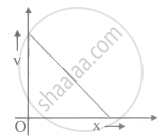
Which of the following graph shows the variation of acceleration (a) with position (x)?
