Advertisements
Advertisements
Question
The graph of one quantity versus another result in a straight line. How are the quantities related to each other?
Advertisements
Solution
Two quantities are directly proportional to each other.
APPEARS IN
RELATED QUESTIONS
A body with an initial velocity x moves with a uniform acceleration y. Plot its velocity-time graph.
Define speed. What is its S.I. unit?
Draw velocity – time graph for the following situation:
When a body, is moving with uniform velocity.
Diagram shows a velocity – time graph for a car starting from rest. The graph has three sections AB, BC and CD.
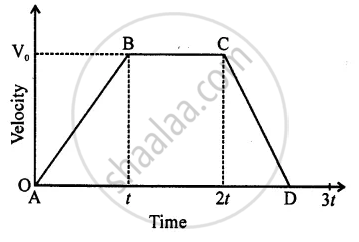
From a study of this graph, state how the distance travelled in any section is determined.
A body at rest is thrown downward from the top of the tower. Draw a distance – time graph of its free fall under gravity during the first 3 seconds. Show your table of values starting t = 0 with an interval of 1 second, (g = 10 ms−2).
What can you say about the nature of motion of a body of its displacement-time graph is:
A straight line inclined to the time axis with an acute angle?
What can you say about the motion of a body if:
Its time-velocity graph is a straight line
Draw velocity-time graph to show:
Zero acceleration
Write a sentence to explain the shape of graph.
Figure shows the distance-time graph of three students A, B and C. On the basis of the graph, answer the following :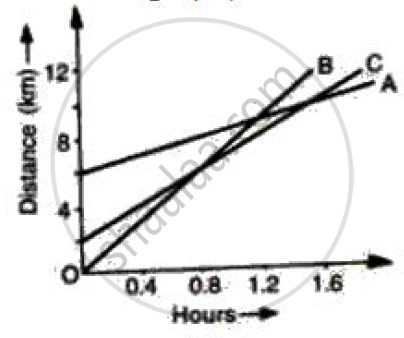
Which of the three is traveling the fastest?
The given graph shows the variation of velocity (v) with position (x) for a particle moving along a straight line
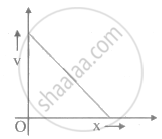
Which of the following graph shows the variation of acceleration (a) with position (x)?
