Advertisements
Advertisements
Question
Draw a velocity-time graph for the free fall of a body under gravity starting from rest. Take g = 10m s-2
Advertisements
Solution
Below is the velocity-time graph for the free fall of a body under gravity, starting from rest:

APPEARS IN
RELATED QUESTIONS
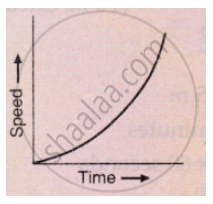
What conclusion can you draw about the acceleration of a body from the speed-time graph shown below .
Name the two quantities, the slope of whose graph give acceleration.
The velocity-time graph for part of a train journey is a horizontal straight line. What does this tell you about the trains velocity.
The velocity-time graph for part of a train journey is a horizontal straight line. What does this tell you about its acceleration ?
Multiple choice Question. Select the correct option.
The slope of displacement – time graph represents.
What does the area of an acceleration – time graph represent?
Diagram shows a velocity – time graph for a car starting from rest. The graph has three sections AB, BC and CD.
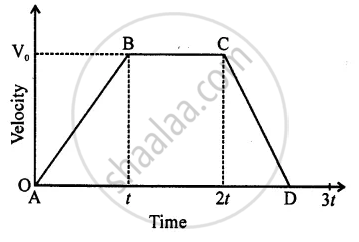
Compare the distance travelled in section BC with the distance travelled in section AB.
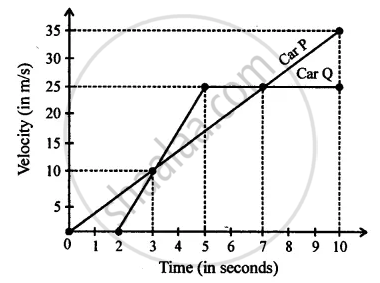
Diagram is given below shows velocity – time graph of car P and Q, starting from the same place and in the same direction. Calculate which car is ahead after 10 s and by how much?
Draw distance-time graph to show:
Increasing velocity
State whether true or false. If false, correct the statement.
If the velocity – time graph of a particle is a straight line inclined to X-axis then its displacement – time graph will be a straight line.
