Advertisements
Advertisements
Question
Draw a graph for acceleration against time for a uniformly accelerated motion. How can it be used to find the change in speed in a certain interval of time?
Advertisements
Solution

The area enclosed between the straight line and time axis for each interval of time gives the value of change in speed in that interval of time.
APPEARS IN
RELATED QUESTIONS
Define the term acceleration due to gravity. State its average value.
The unit of retardation is ____________
A train starts from rest and accelerates uniformly at a rate of 2 m s−2 for 10 s. It then maintains a constant speed for 200 s. The brakes are then applied and the train is uniformly retarded and comes to rest in 50 s. Find
- The maximum velocity reached,
- The retardation in the last 50 s,
- The total distance travelled,
- The average velocity of the train.
A truck running at 90 kmh−1, is brought to rest over a distance of 25 m. Calculate the retardation and time for which brakes are applied.
What is the SI unit of acceleration?
The graph shows how the velocity of a scooter varies with time in 50 s.
Work out: Acceleration.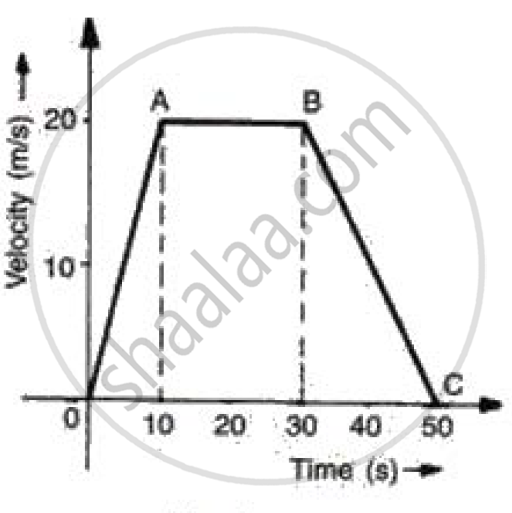
A car accelerates to a velocity of 30 m/s in 10 s and then decelerates for 20 s so that it stops. Draw a velocity-time graph to represent the motion and find:
The acceleration.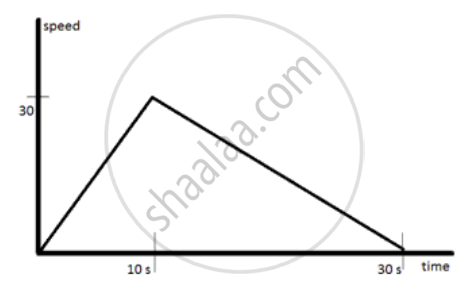
A car accelerates to a velocity of 30 m/s in 10 s and then decelerates for 20 s so that it stops. Draw a velocity-time graph to represent the motion and find:
The Deceleration.
The Unit of acceleration is ______.
What is meant by negative acceleration?
