Advertisements
Advertisements
Question
A racing car is moving with a velocity of 50 m/s. On
applying brakes, it is uniformly retarded and comes to rest in 20 seconds. Calculate its acceleration.
Advertisements
Solution
Initial velocity of car = u = 50 m/s
Final velocity of car = v = 0 .......[∵ As car comes to rest]
Time = t = 20s
Acceleration = a = ?
v = u + at
0 = 50 + a(20)
−20a = 50
a = `(-50)/20` = −2.5 ms−2
APPEARS IN
RELATED QUESTIONS
Define acceleration. State its unit.
Figure given below shows a velocity-time graph for a car starting from rest. The graph has three parts AB, BC and CD.
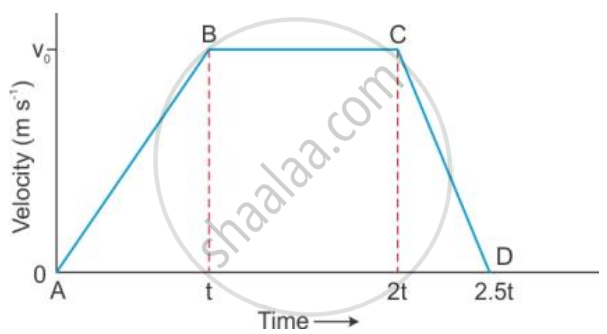
Which part of graph shows motion with uniform
(a) velocity (b) acceleration (c) retardation ?
A train moving with a velocity of 20 ms−1 is brought to rest by applying brakes in 5 s. Calculate the retardation.
A train starts from rest and accelerates uniformly at a rate of 2 m s−2 for 10 s. It then maintains a constant speed for 200 s. The brakes are then applied and the train is uniformly retarded and comes to rest in 50 s. Find
- The maximum velocity reached,
- The retardation in the last 50 s,
- The total distance travelled,
- The average velocity of the train.
Give an example of an accelerated body, moving with a uniform speed.
Draw velocity – time graph for the following situation:
When a body is moving with variable velocity, but uniform retardation.
A truck running at 90 kmh−1, is brought to rest over a distance of 25 m. Calculate the retardation and time for which brakes are applied.
The speed of a car increases from 10 km/h to 64 km/h in 10 seconds. What will be its acceleration?
Convert the following acceleration:
1/36 m/s2 into km/h2
The slope of a velocity-time graph gives ______.
