Advertisements
Advertisements
Question
State the type of motion represented by the following sketches in Figures.
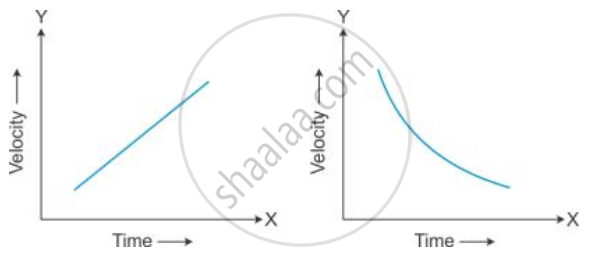
Give an example of each type of motion.
Advertisements
Solution
-
Type of Motion:Uniform Acceleration
-
The graph shows a straight line with a positive slope, indicating that velocity increases at a constant rate over time.
-
This means the object is accelerating uniformly.
Example:
A car increasing its speed steadily on a straight road (e.g., from 0 km/h to 60 km/h in 10 seconds at a constant rate). -
-
Type of Motion: Non-Uniform Retardation (Deceleration)
-
The graph shows a curved line with a decreasing slope, indicating that velocity is decreasing over time, but not at a constant rate.
-
This means the object is slowing down, and the rate of slowing down is changing.
Example:
A bicycle coming to a stop when brakes are applied gently and gradually. -
APPEARS IN
RELATED QUESTIONS
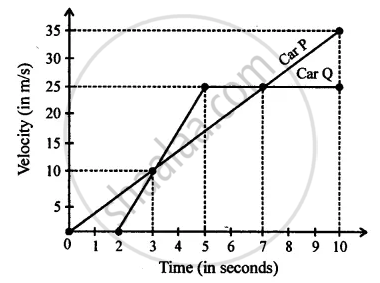
Diagram is given below shows velocity – time graph of car P and Q, starting from the same place and in the same direction. Calculate the Acceleration of car Q between 2 s – 5 s.
A cyclist driving at 5 ms−1, picks a velocity of 10 ms−1, over a distance of 50 m. Calculate
- acceleration
- time in which the cyclist picks up above velocity.
What is the SI unit of acceleration?
Is it possible for an accelerating body to have constant speed?
Convert the following acceleration:
7200 km/h2 into m/s2
The graph shows how the velocity of a scooter varies with time in 50 s.
Work out: Acceleration.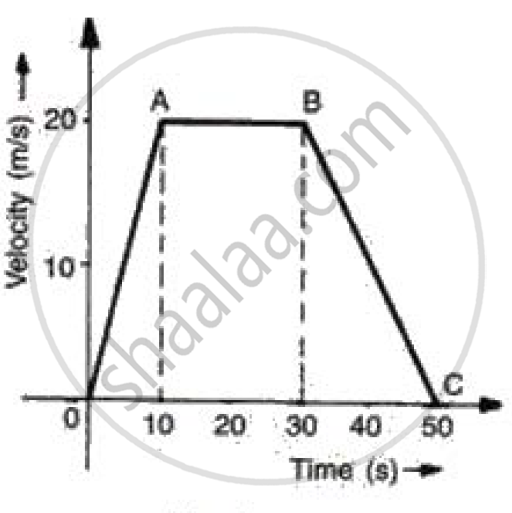
Correct your friend who says that acceleration gives the idea of how fast the position changes.
State whether true or false. If false, correct the statement.
Acceleration can get negative value also.
Exercise Problem.
A racing car has a uniform acceleration of 4 ms–2. What distance it covers in 10 s after the start?
Acceleration is defined as the rate of change of ______.
