Advertisements
Advertisements
Question
The acceleration of a moving body is constant in magnitude and direction. Must the path of the body be a straight line?
If not, given an example.
Advertisements
Solution
If the acceleration of a moving body is constant in magnitude and direction then the path of the body must not be a straight line because in circular motion also acceleration of a body is constant in magnitude and always directed towards the centre.
So the path of the body may be a straight line and may be a circular one.
APPEARS IN
RELATED QUESTIONS
Figure shows the velocity-time graphs for two cars A and B moving in the same direction. Which car has greater acceleration? Give reasons to your answer.

Figure given below shows a velocity-time graph for a car starting from rest. The graph has three parts AB, BC and CD.
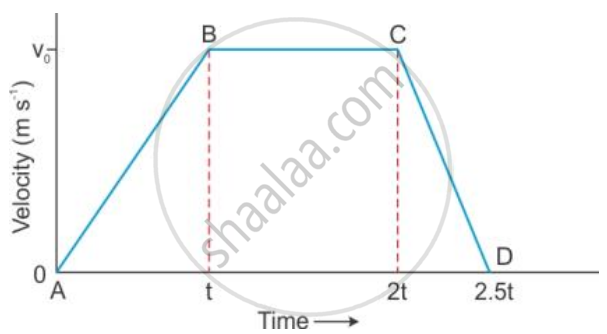
(a) Is the magnitude of acceleration higher or lower than that of retardation ? Give a reason .
(b) Compare the magnitude of acceleration and retardation .
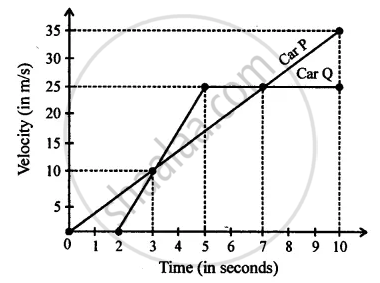
Diagram is given below shows velocity – time graph of car P and Q, starting from the same place and in the same direction. Calculate the Acceleration of car P.
A cyclist driving at 5 ms−1, picks a velocity of 10 ms−1, over a distance of 50 m. Calculate
- acceleration
- time in which the cyclist picks up above velocity.
What does a positive acceleration mean?
The initial velocity of a car is 10 ms-1. It moves with an acceleration of 2 ms-2. What will be its speed after 10 seconds?
A car accelerates to a velocity of 30 m/s in 10 s and then decelerates for 20 s so that it stops. Draw a velocity-time graph to represent the motion and find:
Distance travelled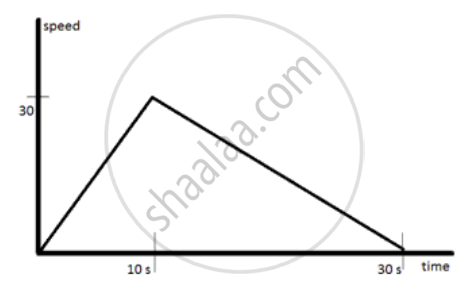
What do you understand about negative acceleration?
The slope of a velocity-time graph gives ______.
A boy throws a ball up and catches it when the ball falls back. In which part of the motion the ball is accelerating?
