Advertisements
Advertisements
Question
A car accelerates to a velocity of 30 m/s in 10 s and then decelerates for 20 s so that it stops. Draw a velocity-time graph to represent the motion and find:
Distance travelled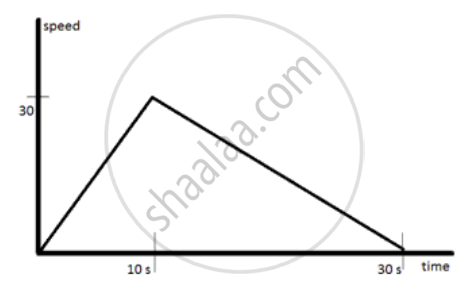
Advertisements
Solution

Distance travelled= area under speed time graph = `1/2`x30x30 =450 m.
APPEARS IN
RELATED QUESTIONS
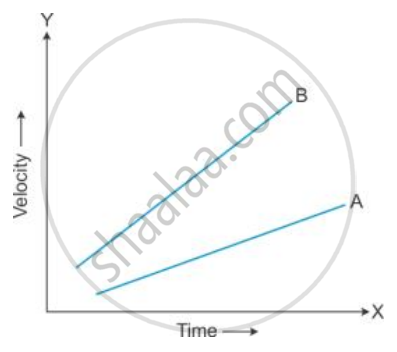
Figure shows the velocity-time graphs for two cars A and B moving in the same direction. Which car has greater acceleration? Give reasons to your answer.
If a body is moving with a constant velocity its acceleration is ______.
An aeroplane lands at 216 kmh−1 and stops after covering a runway of 2 m. Calculate the acceleration and the time, in which it comes to rest.
The speed of a car increases from 10 km/h to 64 km/h in 10 seconds. What will be its acceleration?
Assertion: The accelerated motion of an object may be due to change in magnitude of velocity or direction or both of them.
Reason: Acceleration can be produced only by change in magnitude of the velocity. It does not depend the direction.
Exercise Problem.
A racing car has a uniform acceleration of 4 ms–2. What distance it covers in 10 s after the start?
Acceleration is defined as the rate of change of ______.
The value of acceleration for a body at rest is ______.
Acceleration is a scalar.
Assertion: A positive acceleration of a body can be associated with the slowing down of the body.
Reason: Acceleration is a vector.
