Advertisements
Advertisements
प्रश्न
A car accelerates to a velocity of 30 m/s in 10 s and then decelerates for 20 s so that it stops. Draw a velocity-time graph to represent the motion and find:
Distance travelled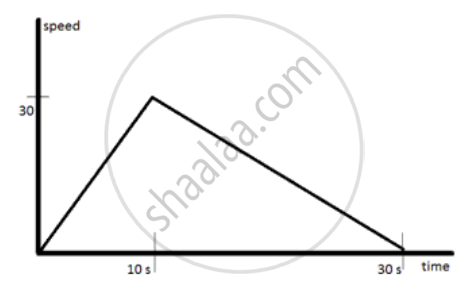
Advertisements
उत्तर

Distance travelled= area under speed time graph = `1/2`x30x30 =450 m.
APPEARS IN
संबंधित प्रश्न
Define acceleration. State its unit.
What is meant by the term retardation? Name its S.I. unit.
The acceleration of a body is 8.5 ms-2. What does this statement mean?
A car traveling at 60 km/h, stops on applying brakes in 10 seconds. What is its acceleration?
What happens to the stepwise increasing speed-time graph when the size of each step is made very small?
A car is moving with a speed of 50 km/h. One second later, its speed is 55 km/h. What is its acceleration?
A car accelerates to a velocity of 30 m/s in 10 s and then decelerates for 20 s so that it stops. Draw a velocity-time graph to represent the motion and find:
The Deceleration.
Negative acceleration is called ______.
State whether true or false. If false, correct the statement.
Acceleration can get negative value also.
It is possible to have objects moving with uniform speed but variable acceleration.
