Advertisements
Advertisements
प्रश्न
A truck running at 90 kmh−1, is brought to rest over a distance of 25 m. Calculate the retardation and time for which brakes are applied.
Advertisements
उत्तर
Initial velocity = u = 90 kmh−1 = `90xx5/18` ms−1
u = 25 ms−1
Final velocity = v = 0
Distance = S = 25 m
v2 − u2 = 2aS
(0)2 − (25)2 = 2a (25)
50a = −625
(retardation) a = `(-625)/50` = −12.5 ms−2
Now, v = u + at
0 = 25 + (−12.5)t
12.5t = 25
(Time) t = `25/12.5` = 2s
APPEARS IN
संबंधित प्रश्न
The unit of retardation is ____________
If a body is moving with a constant velocity its acceleration is ______.
Convert the following acceleration:
1/36 m/s2 into km/h2
The graph shows how the velocity of a scooter varies with time in 50 s.
Work out: Acceleration.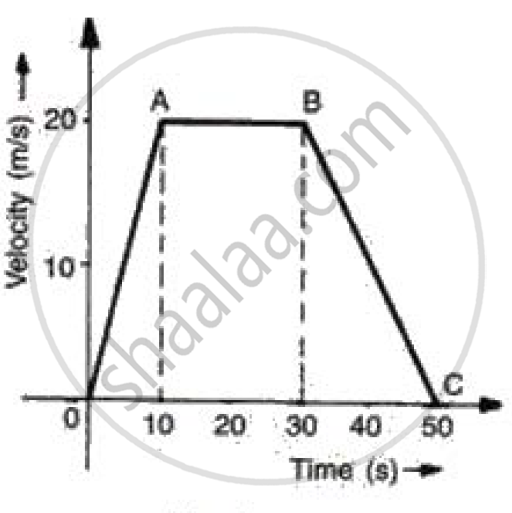
State whether true or false. If false, correct the statement.
Acceleration can get negative value also.
Assertion: The accelerated motion of an object may be due to change in magnitude of velocity or direction or both of them.
Reason: Acceleration can be produced only by change in magnitude of the velocity. It does not depend the direction.
When a body starts from rest, the acceleration of the body after 2 seconds in ______ of its displacement.
The acceleration of the body that moves with a uniform velocity will be ______.
The value of acceleration for a body at rest is ______.
An object can be moving with uniform speed but with variable acceleration.
