Advertisements
Advertisements
प्रश्न
A train moving with a velocity of 20 ms−1 is brought to rest by applying brakes in 5 s. Calculate the retardation.
Advertisements
उत्तर
Given:
-
Initial velocity, u = 20 m/s
-
Final velocity, v = 0 m/s (since train comes to rest)
-
Time, t = 5 s
0 = 20 + a × 5
0 = 20 + 5a
5a = −20
a = −4m/s2
Retardation = 4 m/s2
APPEARS IN
संबंधित प्रश्न
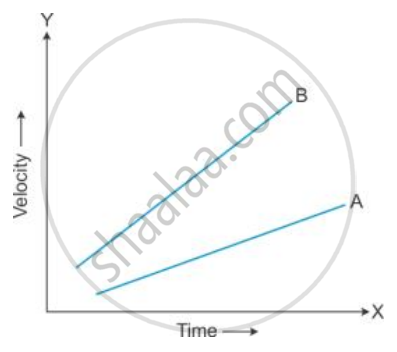
Figure shows the velocity-time graphs for two cars A and B moving in the same direction. Which car has greater acceleration? Give reasons to your answer.
When is the acceleration due to gravity positive?
When is the acceleration due to gravity negative?
A body falls towards the earth. Does it have positive or negative acceleration?
Write the SI unit of retardation.
Distinguish between uniformly and non-uniformly accelerated motions.
Convert the following acceleration:
1/36 m/s2 into km/h2
Figure represents graphically the velocity of a car moving along a straight road over a period of 100 hours.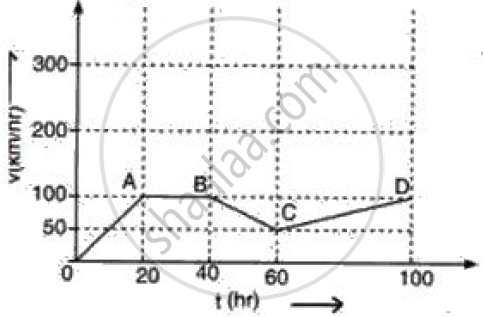
Calculate the acceleration along AB and the retardation along BC.
A quantity has a value of 16ms-2. It is the ______.
The value of acceleration for a body at rest is ______.
