Advertisements
Advertisements
प्रश्न
A train moving with a velocity of 20 ms−1 is brought to rest by applying brakes in 5 s. Calculate the retardation.
Advertisements
उत्तर
Given:
-
Initial velocity, u = 20 m/s
-
Final velocity, v = 0 m/s (since train comes to rest)
-
Time, t = 5 s
0 = 20 + a × 5
0 = 20 + 5a
5a = −20
a = −4m/s2
Retardation = 4 m/s2
APPEARS IN
संबंधित प्रश्न
A body is moving vertically upwards. Its velocity changes at a constant rate from 50 m s−1 to 20 m s−1 in 3 s. What is its acceleration?
A toy car initially moving with uniform velocity of 18 km h-1 comes to a stop in 2 s. Find the retardation of the car in S.I. units.
A bullet initially moving with a velocity 20 m/s strikes a target and comes to rest after penetrating a distance 10 cm into the target. Calculate the retardation caused by the target.
State its value in C.G.S. as well as in S.I. system.
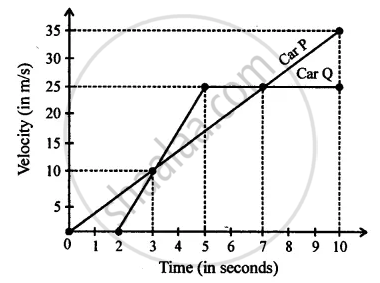
Diagram is given below shows velocity – time graph of car P and Q, starting from the same place and in the same direction. Calculate the Acceleration of car P.
The distance covered by a body is directly proportional to the square of the time elapsed. What can you say about its acceleration?
A car accelerates to a velocity of 30 m/s in 10 s and then decelerates for 20 s so that it stops. Draw a velocity-time graph to represent the motion and find:
The acceleration.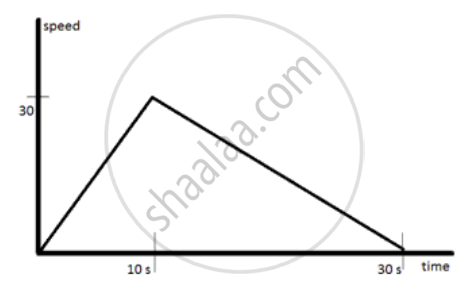
State whether true or false. If false, correct the statement.
Acceleration can get negative value also.
m/s2 is the unit of ______.
Acceleration is a scalar.
