Advertisements
Advertisements
प्रश्न
A bullet initially moving with a velocity 20 m/s strikes a target and comes to rest after penetrating a distance 10 cm into the target. Calculate the retardation caused by the target.
Advertisements
उत्तर
Initial velocity u = 20 m/s
Final velocity v = 0
Distance travelled s = 10 cm = 0.1 m
Let acceleration be 'a'.
Using the third equation of motion,
v2 − u2 = 2as
We get,
(0) 2 − (20) 2 = 2(a) (0.1)
a = −(400/0.2) m/s2
a = −2000 m/s2
Thus, retardation = 2000 m/s2
APPEARS IN
संबंधित प्रश्न
What is meant by the term retardation? Name its S.I. unit.
Figure given below shows a velocity-time graph for a car starting from rest. The graph has three parts AB, BC and CD.
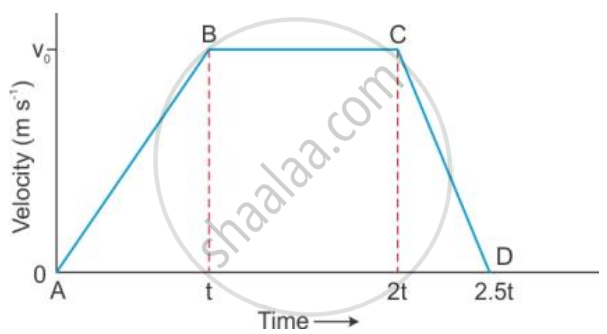
Which part of graph shows motion with uniform
(a) velocity (b) acceleration (c) retardation ?
A train moving with a velocity of 20 ms−1 is brought to rest by applying brakes in 5 s. Calculate the retardation.
A space craft flying in a straight course with velocity of 75 km s-1 fires its rocket motors for 6.0 s. At the end of this time its speed is 120 km s-1 in the same direction.
Find
(i) The space craft's average acceleration while the motors were firing
(ii) The distance travelled by the space craft in the first 10 s after the rocket motors were started, the motors being in action for only 6 s.
A ball is rolling from A to D on a flat and smooth surface. Its speed is 2 cm/s. On reaching B, it was pushed continuously up to C. On reaching D from C, its speed had become 4 cm/s. It took 2 seconds for it to go from B to C. What is the acceleration of the ball as it goes from B to C?

What does a positive acceleration mean?
What do you mean by constant acceleration?
The slope of a velocity-time graph gives ______.
The Unit of acceleration is ______.
When an object undergoes acceleration ______.
