Advertisements
Advertisements
प्रश्न
A racing car is moving with a velocity of 50 m/s. On
applying brakes, it is uniformly retarded and comes to rest in 20 seconds. Calculate its acceleration.
Advertisements
उत्तर
Initial velocity of car = u = 50 m/s
Final velocity of car = v = 0 .......[∵ As car comes to rest]
Time = t = 20s
Acceleration = a = ?
v = u + at
0 = 50 + a(20)
−20a = 50
a = `(-50)/20` = −2.5 ms−2
APPEARS IN
संबंधित प्रश्न
Distinguish between acceleration and retardation.
A train starts from rest and accelerates uniformly at a rate of 2 m s−2 for 10 s. It then maintains a constant speed for 200 s. The brakes are then applied and the train is uniformly retarded and comes to rest in 50 s. Find
- The maximum velocity reached,
- The retardation in the last 50 s,
- The total distance travelled,
- The average velocity of the train.
State its value in C.G.S. as well as in S.I. system.
Diagram is given below shows velocity – time graph of car P and Q, starting from the same place and in the same direction. Calculate the Acceleration of car P.
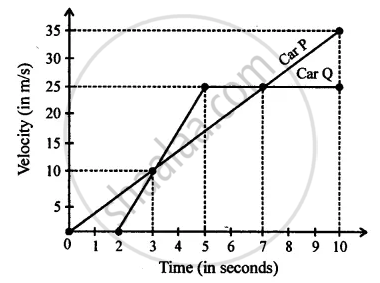
A motorbike, initially at rest, picks up a velocity of 72 kmh−1 over a distance of 40 m. Calculate
- acceleration
- time in which it picks up above velocity.
The acceleration of a body is 8.5 ms-2. What does this statement mean?
Distinguish between uniformly and non-uniformly accelerated motions.
State if the following situation is possible:
A body moving horizontally with an acceleration in vertical direction.
m/s2 is the unit of ______.
