Advertisements
Advertisements
प्रश्न
State whether true or false. If false, correct the statement.
Acceleration can get negative value also.
पर्याय
True
false
Advertisements
उत्तर
Acceleration can get negative value also- True
APPEARS IN
संबंधित प्रश्न
A train starts from rest and accelerates uniformly at a rate of 2 m s−2 for 10 s. It then maintains a constant speed for 200 s. The brakes are then applied and the train is uniformly retarded and comes to rest in 50 s. Find
- The maximum velocity reached,
- The retardation in the last 50 s,
- The total distance travelled,
- The average velocity of the train.
A vehicle is accelerating on a straight road. Its velocity at any instant is 30 km/h. After 2 s, it is 33.6 km/h, and after further 2 s, it is 37.2 km/h. Find the acceleration of the vehicle in m s-2. Is the acceleration uniform?
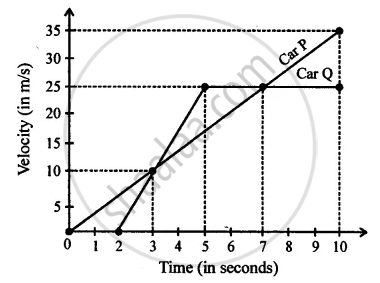
Diagram is given below shows velocity – time graph of car P and Q, starting from the same place and in the same direction. Calculate the Acceleration of car P.
A car traveling at 60 km/h, stops on applying brakes in 10 seconds. What is its acceleration?
The distance covered by a body is directly proportional to the square of the time elapsed. What can you say about its acceleration?
A car accelerates to a velocity of 30 m/s in 10 s and then decelerates for 20 s so that it stops. Draw a velocity-time graph to represent the motion and find:
Distance travelled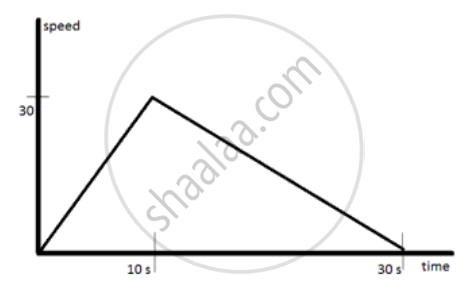
Figure represents graphically the velocity of a car moving along a straight road over a period of 100 hours.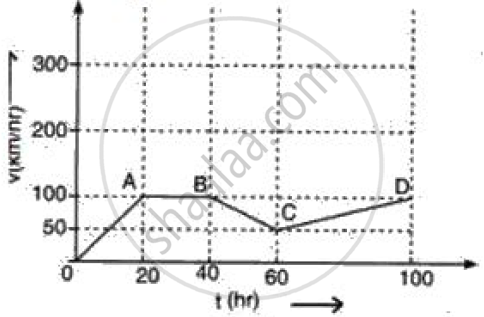
Calculate the acceleration along AB and the retardation along BC.
A boy throws a ball up and catches it when the ball falls back. In which part of the motion the ball is accelerating?
A car is being driven at a speed of 20ms-1 when brakes are applied to bring it to rest in 5 s. The deceleration produced in this case will be ______.
The value of acceleration for a body at rest is ______.
