Advertisements
Advertisements
प्रश्न
A car travels with uniform velocity of 25 m s-1 for 5 s. The brakes are then applied and the car is uniformly retarded and comes to rest in further 10 s. Find:
- The distance which the car travels before the brakes are applied,
- Retardation and
- The distance travelled by car after applying the brakes.
Advertisements
उत्तर
(i) As we know, Distance = Speed × time
Initial velocity (u) = 25 m s-1; Final velocity (v) = 0; time = 5 s
Substituting the values in the formula,
Distance = Speed × time
Distance = (25) × (5) m
∴ Distance = 125 m
(ii) Acceleration = `("Final velocity" - "Initial velocity")/"Time taken"`
∴ a = `("v" - "u")/"t"`
= `(0 - 25)/10` ms-2
= `(-5)/2` ms-2
= - 2.5 ms-2
∵ If v < u, then a is negative, and a is the retardation.
Therefore, retardation = 2.5 ms-2
(iii) After applying brakes, the time taken to come to stop = 10 s
Let S' be the distance travelled after applying the brakes.
Initial velocity u = 25 m/s
Final velocity v = 0
Using the third equation of motion,
∴ v2 - u2 = 2as
We get,
⇒ (0) 2 - (25)2 = 2 (- 2.5) (S')
⇒ 625 = 5(S')
⇒ `625/5` = S'
⇒ S' = 125 m
APPEARS IN
संबंधित प्रश्न
A toy car initially moving with uniform velocity of 18 km h-1 comes to a stop in 2 s. Find the retardation of the car in S.I. units.
If a body is moving with a constant velocity its acceleration is ______.
A truck running at 90 kmh−1, is brought to rest over a distance of 25 m. Calculate the retardation and time for which brakes are applied.
Convert the following acceleration:
1/36 m/s2 into km/h2
A car is moving with a speed of 50 km/h. One second later, its speed is 55 km/h. What is its acceleration?
A car accelerates to a velocity of 30 m/s in 10 s and then decelerates for 20 s so that it stops. Draw a velocity-time graph to represent the motion and find:
The acceleration.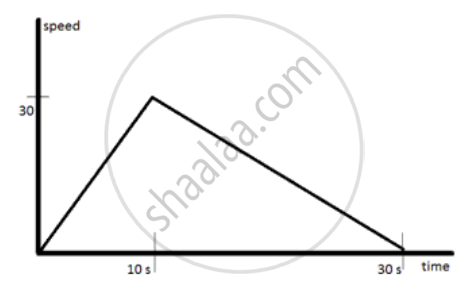
A car accelerates to a velocity of 30 m/s in 10 s and then decelerates for 20 s so that it stops. Draw a velocity-time graph to represent the motion and find:
Distance travelled
If the velocity of a body does not change, then its acceleration is ______.
If a moving body comes to rest, then its acceleration is ______.
When a body is said to be in
- uniform acceleration
- non–uniform acceleration?
