Advertisements
Advertisements
प्रश्न
A car is moving with a speed of 50 km/h. One second later, its speed is 55 km/h. What is its acceleration?
Advertisements
उत्तर
Initial speed of car u = 50 km/h.
Final speed of car v = 55 km/h.
Time taken by car to attain this speed is = 1 sec. = 1/3600 hr.
Acceleration of the car is = (55 - 50 )X 3600 = 18000 kmh-2.
APPEARS IN
संबंधित प्रश्न
A space craft flying in a straight course with velocity of 75 km s-1 fires its rocket motors for 6.0 s. At the end of this time its speed is 120 km s-1 in the same direction.
Find
(i) The space craft's average acceleration while the motors were firing
(ii) The distance travelled by the space craft in the first 10 s after the rocket motors were started, the motors being in action for only 6 s.
A car travels with uniform velocity of 25 m s-1 for 5 s. The brakes are then applied and the car is uniformly retarded and comes to rest in further 10 s. Find:
- The distance which the car travels before the brakes are applied,
- Retardation and
- The distance travelled by car after applying the brakes.
Draw velocity – time graph for the following situation:
When a body is moving with variable velocity and variable acceleration.
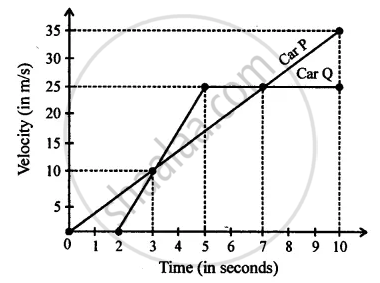
Diagram is given below shows velocity – time graph of car P and Q, starting from the same place and in the same direction. Calculate the Acceleration of car P.
The distance covered by a body is directly proportional to the square of the time elapsed. What can you say about its acceleration?
Interpret the following graph: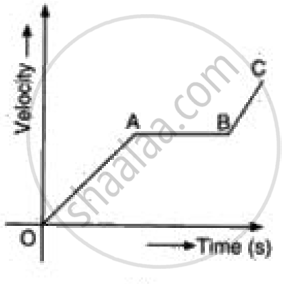
The graph shows how the velocity of a scooter varies with time in 50 s.
Work out: Acceleration.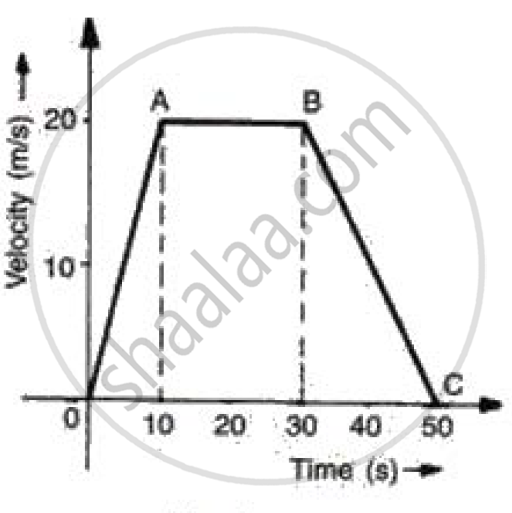
Correct your friend who says that acceleration gives the idea of how fast the position changes.
When a body starts from rest, the acceleration of the body after 2 seconds in ______ of its displacement.
What is the difference between uniform acceleration and non–uniform acceleration?
