Advertisements
Advertisements
प्रश्न
A truck running at 90 kmh−1, is brought to rest over a distance of 25 m. Calculate the retardation and time for which brakes are applied.
Advertisements
उत्तर
Initial velocity = u = 90 kmh−1 = `90xx5/18` ms−1
u = 25 ms−1
Final velocity = v = 0
Distance = S = 25 m
v2 − u2 = 2aS
(0)2 − (25)2 = 2a (25)
50a = −625
(retardation) a = `(-625)/50` = −12.5 ms−2
Now, v = u + at
0 = 25 + (−12.5)t
12.5t = 25
(Time) t = `25/12.5` = 2s
APPEARS IN
संबंधित प्रश्न
A ball is rolling from A to D on a flat and smooth surface. Its speed is 2 cm/s. On reaching B, it was pushed continuously up to C. On reaching D from C, its speed had become 4 cm/s. It took 2 seconds for it to go from B to C. What is the acceleration of the ball as it goes from B to C?

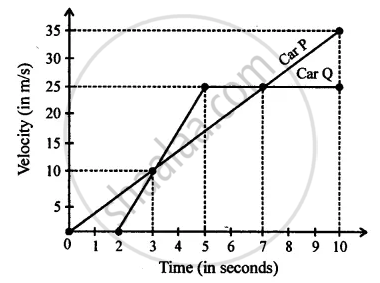
Diagram is given below shows velocity – time graph of car P and Q, starting from the same place and in the same direction. Calculate the Acceleration of car Q between 2 s – 5 s.
The graph shows how the velocity of a scooter varies with time in 50 s.
Work out: Deceleration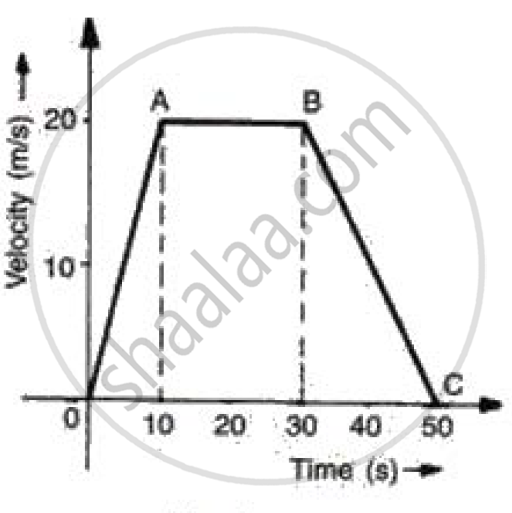
The rate of change of velocity is ______.
Correct your friend who says that acceleration gives the idea of how fast the position changes.
The speed of a particle is constant. Will it have acceleration? Justify with an example.
When an object undergoes acceleration ______.
A boy throws a ball up and catches it when the ball falls back. In which part of the motion the ball is accelerating?
Assertion: Position-time graph of a stationary object is a straight line parallel to the time axis.
Reason: For a stationary object, the position does not change with time.
