Advertisements
Advertisements
Question
A truck running at 90 kmh−1, is brought to rest over a distance of 25 m. Calculate the retardation and time for which brakes are applied.
Advertisements
Solution
Initial velocity = u = 90 kmh−1 = `90xx5/18` ms−1
u = 25 ms−1
Final velocity = v = 0
Distance = S = 25 m
v2 − u2 = 2aS
(0)2 − (25)2 = 2a (25)
50a = −625
(retardation) a = `(-625)/50` = −12.5 ms−2
Now, v = u + at
0 = 25 + (−12.5)t
12.5t = 25
(Time) t = `25/12.5` = 2s
APPEARS IN
RELATED QUESTIONS
A cyclist driving at 5 ms−1, picks a velocity of 10 ms−1, over a distance of 50 m. Calculate
- acceleration
- time in which the cyclist picks up above velocity.
A motor bike running at 5 ms−1, picks up a velocity of 30 ms−1 in 5s. Calculate
- acceleration
- distance covered during acceleration.
Write the SI unit of acceleration and retardation.
Can you use the relation [B1]?
State if the following situation is possible:
A body moving with constant acceleration but with Zero velocity.
Interpret the following graph: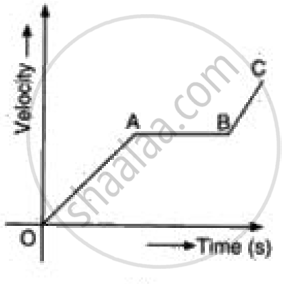
A bus can accelerate with an acceleration of 1 m/s2 . Find the minimum time for the bus to attain the speed of 100 km/s from 50 km /s.
A quantity has a value of 16ms-2. It is the ______.
A car is being driven at a speed of 20ms-1 when brakes are applied to bring it to rest in 5 s. The deceleration produced in this case will be ______.
Assertion: Position-time graph of a stationary object is a straight line parallel to the time axis.
Reason: For a stationary object, the position does not change with time.
