Advertisements
Advertisements
Question
A car accelerates to a velocity of 30 m/s in 10 s and then decelerates for 20 s so that it stops. Draw a velocity-time graph to represent the motion and find:
The Deceleration.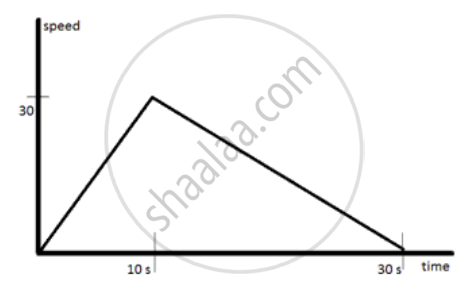
Advertisements
Solution

Deceleration a = ( v - u )/t = ( o - 30 )/ 20 = -1.5 ms-2
APPEARS IN
RELATED QUESTIONS
Define acceleration. State its unit.
A body falls freely from a certain height. Show graphically the relation between the distance fallen and square of time. How will you determine g from this graph?
A train moving with a velocity of 20 ms−1 is brought to rest by applying brakes in 5 s. Calculate the retardation.
A car travels with uniform velocity of 25 m s-1 for 5 s. The brakes are then applied and the car is uniformly retarded and comes to rest in further 10 s. Find:
- The distance which the car travels before the brakes are applied,
- Retardation and
- The distance travelled by car after applying the brakes.
What is the SI unit of acceleration?
Distinguish between uniformly and non-uniformly accelerated motions.
Interpret the following graph: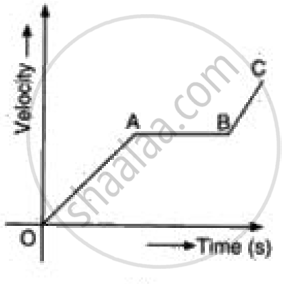
The value of acceleration for a body at rest is ______.
Assertion: A positive acceleration of a body can be associated with the slowing down of the body.
Reason: Acceleration is a vector.
What is the difference between uniform acceleration and non–uniform acceleration?
