Advertisements
Advertisements
Question
An aeroplane lands at 216 kmh−1 and stops after covering a runway of 2 m. Calculate the acceleration and the time, in which it comes to rest.
Advertisements
Solution
Initial velocity = u = 216 kmh−1
u = `216xx5/18` = 60 ms−1
Final velocity = v = 0
Distance = S = 2 km = 2000 m
v2 − u2 = 2aS
(0)2 − (60)2 = 2a (2000)
4000 a = −3600
(Acceleration) a = `(-3600)/4000`
= −0.9 ms−2
Now, v = u + at
0 = 60 + (−0.9)t
0.9t = 60
(Time) t = `60/0.9=600/9` = 66.67 S
APPEARS IN
RELATED QUESTIONS
A body is moving vertically upwards. Its velocity changes at a constant rate from 50 m s−1 to 20 m s−1 in 3 s. What is its acceleration?
A toy car initially moving with uniform velocity of 18 km h-1 comes to a stop in 2 s. Find the retardation of the car in S.I. units.
A vehicle is accelerating on a straight road. Its velocity at any instant is 30 km/h. After 2 s, it is 33.6 km/h, and after further 2 s, it is 37.2 km/h. Find the acceleration of the vehicle in m s-2. Is the acceleration uniform?
Give an example of an accelerated body, moving with a uniform speed.
A truck running at 90 kmh−1, is brought to rest over a distance of 25 m. Calculate the retardation and time for which brakes are applied.
Convert the following acceleration:
1/36 m/s2 into km/h2
A car is moving with a speed of 50 km/h. One second later, its speed is 55 km/h. What is its acceleration?
The graph shows how the velocity of a scooter varies with time in 50 s.
Work out: Acceleration.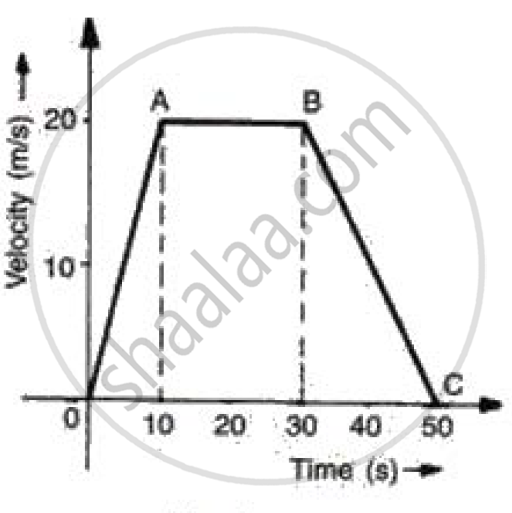
A bus can accelerate with an acceleration of 1 m/s2 . Find the minimum time for the bus to attain the speed of 100 km/s from 50 km /s.
A bus accelerating with 4ms-2 changes its speed from 60ms_1 to a certain value in 5s. The final speed is ______.
