Advertisements
Advertisements
Question
State if the following situation is possible:
A body moving with a constant velocity in an accelerated motion.
Advertisements
Solution
No in an accelerated motion a body cannot have a constant velocity.
APPEARS IN
RELATED QUESTIONS
Give a scientific reason.
When an object falls freely to the ground, its acceleration is uniform.
A car travels with uniform velocity of 25 m s-1 for 5 s. The brakes are then applied and the car is uniformly retarded and comes to rest in further 10 s. Find:
- The distance which the car travels before the brakes are applied,
- Retardation and
- The distance travelled by car after applying the brakes.
When is the acceleration due to gravity positive?
Draw velocity – time graph for the following situation:
When a body is moving with variable velocity, but uniform retardation.
A cyclist driving at 5 ms−1, picks a velocity of 10 ms−1, over a distance of 50 m. Calculate
- acceleration
- time in which the cyclist picks up above velocity.
What does a positive acceleration mean?
Write the SI unit of acceleration and retardation.
The graph shows how the velocity of a scooter varies with time in 50 s.
Work out: Deceleration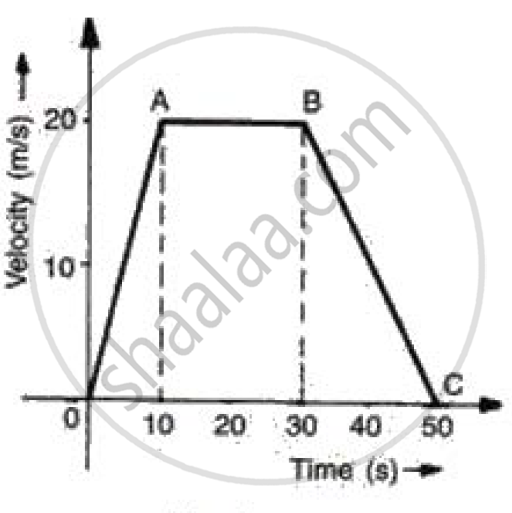
A car accelerates to a velocity of 30 m/s in 10 s and then decelerates for 20 s so that it stops. Draw a velocity-time graph to represent the motion and find:
The Deceleration.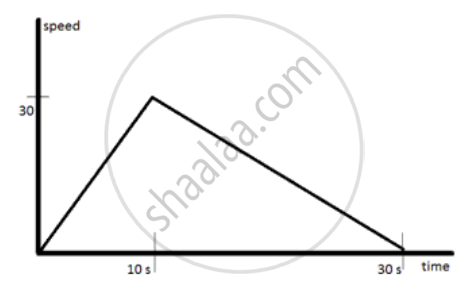
m/s2 is the unit of ______.
