Advertisements
Advertisements
Question
A bus can accelerate with an acceleration of 1 m/s2 . Find the minimum time for the bus to attain the speed of 100 km/s from 50 km /s.
Advertisements
Solution
Acceleration of the bus (a) = 1 m/s2
Initial velocity (u) = 50 km/s = 50 x 103 m/s
Final velocity (v) = 100 km/s = 100 x 103 m/s
time (t) = ?
`"t "= ("v"-"u") /"t"= (100xx10^3 - 50xx10^3)/1 = ((100-50)xx10^3)/1`
t = 50 × 103 s
APPEARS IN
RELATED QUESTIONS
An object of mass 16 kg is moving with an acceleration of 3 m/s2. Calculate the applied force. If the same force is applied to an object of mass 24 kg, how much will be the acceleration?
Give one example of the following motion:
Uniform retardation
State the type of motion represented by the following sketches in Figures.
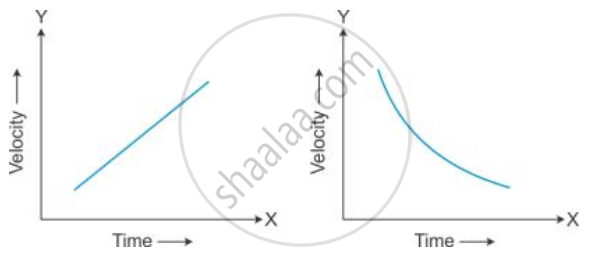
Give an example of each type of motion.
A train starts from rest and accelerates uniformly at a rate of 2 m s−2 for 10 s. It then maintains a constant speed for 200 s. The brakes are then applied and the train is uniformly retarded and comes to rest in 50 s. Find
- The maximum velocity reached,
- The retardation in the last 50 s,
- The total distance travelled,
- The average velocity of the train.
From the diagram given below, calculate deceleration.
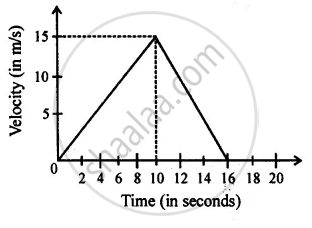
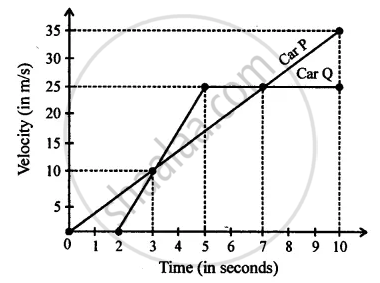
Diagram is given below shows velocity – time graph of car P and Q, starting from the same place and in the same direction. Calculate the Acceleration of car P.
An aeroplane lands at 216 kmh−1 and stops after covering a runway of 2 m. Calculate the acceleration and the time, in which it comes to rest.
The speed of a car increases from 10 km/h to 64 km/h in 10 seconds. What will be its acceleration?
The distance covered by a body is directly proportional to the square of the time elapsed. What can you say about its acceleration?
State if the following situation is possible:
A body moving horizontally with an acceleration in vertical direction.
Is it possible for an accelerating body to have constant speed?
Convert the following acceleration:
7200 km/h2 into m/s2
Convert the following acceleration:
1/36 m/s2 into km/h2
A car accelerates to a velocity of 30 m/s in 10 s and then decelerates for 20 s so that it stops. Draw a velocity-time graph to represent the motion and find:
The acceleration.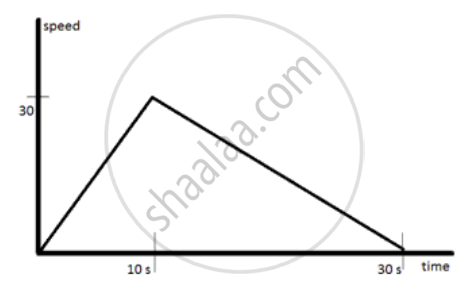
Figure represents graphically the velocity of a car moving along a straight road over a period of 100 hours.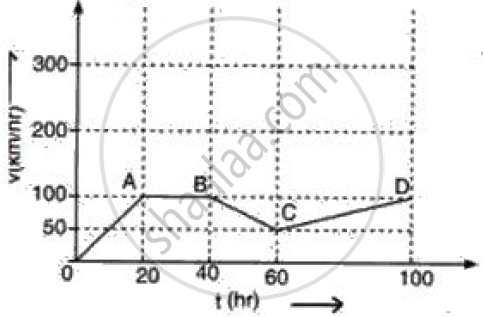
Calculate the acceleration along AB and the retardation along BC.
Correct your friend who says that acceleration gives the idea of how fast the position changes.
The slope of a velocity-time graph gives ______.
It is possible to have objects moving with uniform speed but variable acceleration.
