Advertisements
Advertisements
Question
The rate of change of velocity is ______.
Advertisements
Solution
The rate of change of velocity is acceleration.
APPEARS IN
RELATED QUESTIONS
State the type of motion represented by the following sketches in Figures.
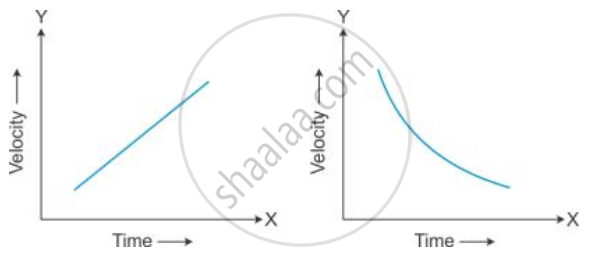
Give an example of each type of motion.
A vehicle is accelerating on a straight road. Its velocity at any instant is 30 km/h. After 2 s, it is 33.6 km/h, and after further 2 s, it is 37.2 km/h. Find the acceleration of the vehicle in m s-2. Is the acceleration uniform?
State its value in C.G.S. as well as in S.I. system.
When is the acceleration due to gravity positive?
When is the acceleration due to gravity negative?
Draw velocity – time graph for the following situation:
When a body is moving with variable velocity, but uniform retardation.
A truck running at 90 kmh−1, is brought to rest over a distance of 25 m. Calculate the retardation and time for which brakes are applied.
A motor bike running at 5 ms−1, picks up a velocity of 30 ms−1 in 5s. Calculate
- acceleration
- distance covered during acceleration.
A cyclist driving at 36 kmh−1 stops his motion in 2 s, by the application of brakes. Calculate
- retardation
- distance covered during the application of brakes.
A body falls towards the earth. Does it have positive or negative acceleration?
Write the SI unit of acceleration and retardation.
The distance covered by a body is directly proportional to the square of the time elapsed. What can you say about its acceleration?
State if the following situation is possible:
A body moving with a constant velocity in an accelerated motion.
Is it possible for an accelerating body to have constant speed?
Sketch the shape of the velocity-time graph for a body moving with:
Uniform acceleration.
A car accelerates to a velocity of 30 m/s in 10 s and then decelerates for 20 s so that it stops. Draw a velocity-time graph to represent the motion and find:
The Deceleration.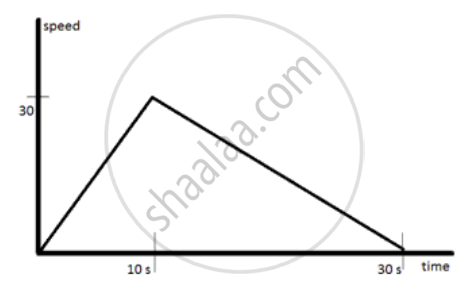
A car accelerates to a velocity of 30 m/s in 10 s and then decelerates for 20 s so that it stops. Draw a velocity-time graph to represent the motion and find:
Distance travelled
From the given v-t graph it can be inferred that an object is

If a moving body comes to rest, then its acceleration is ______.
A car is being driven at a speed of 20ms-1 when brakes are applied to bring it to rest in 5 s. The deceleration produced in this case will be ______.
