Advertisements
Advertisements
Question
A cyclist driving at 36 kmh−1 stops his motion in 2 s, by the application of brakes. Calculate
- retardation
- distance covered during the application of brakes.
Advertisements
Solution
Initial velocity = u = 36 kmh−1
= u = `36xx5/18` ms−1 = 10 ms−1
Final velocity = v = 0
Time = t = 2s
(i) Retardation = a = ?
v = u + at
0 = 10 + a (2)
2a = −10
a = `(-10)/2` = −5 ms−2
(ii) Distance covered S =?
v2 − u2 = 2aS
(0)2 − (10)2 = 2(−5) S
−10S = −100
S = `100/10`
S = 10 m
APPEARS IN
RELATED QUESTIONS
Give one example of the following motion:
Uniform retardation
Figure given below shows a velocity-time graph for a car starting from rest. The graph has three parts AB, BC and CD.
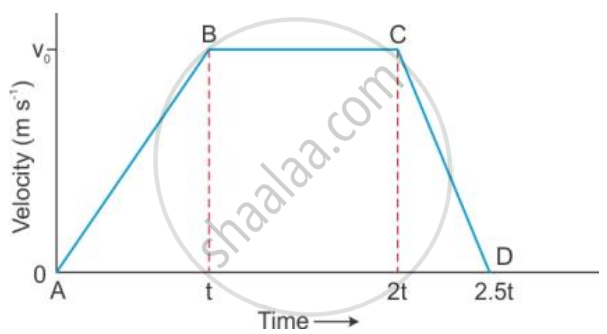
Which part of graph shows motion with uniform
(a) velocity (b) acceleration (c) retardation ?
A vehicle is accelerating on a straight road. Its velocity at any instant is 30 km/h. After 2 s, it is 33.6 km/h, and after further 2 s, it is 37.2 km/h. Find the acceleration of the vehicle in m s-2. Is the acceleration uniform?
When is the acceleration due to gravity negative?
A motorbike, initially at rest, picks up a velocity of 72 kmh−1 over a distance of 40 m. Calculate
- acceleration
- time in which it picks up above velocity.
Is it possible for an accelerating body to have constant speed?
A car accelerates uniformly from a velocity of 18 km/h to 36 km/h in 15 min. What is its acceleration?
A car accelerates to a velocity of 30 m/s in 10 s and then decelerates for 20 s so that it stops. Draw a velocity-time graph to represent the motion and find:
The acceleration.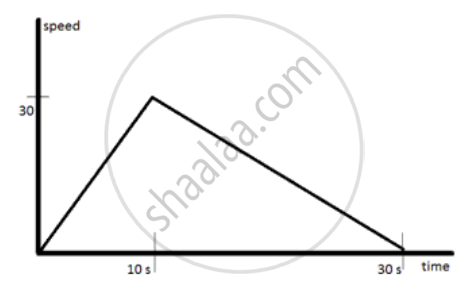
Acceleration is defined as the rate of change of ______.
What is the difference between uniform acceleration and non–uniform acceleration?
